





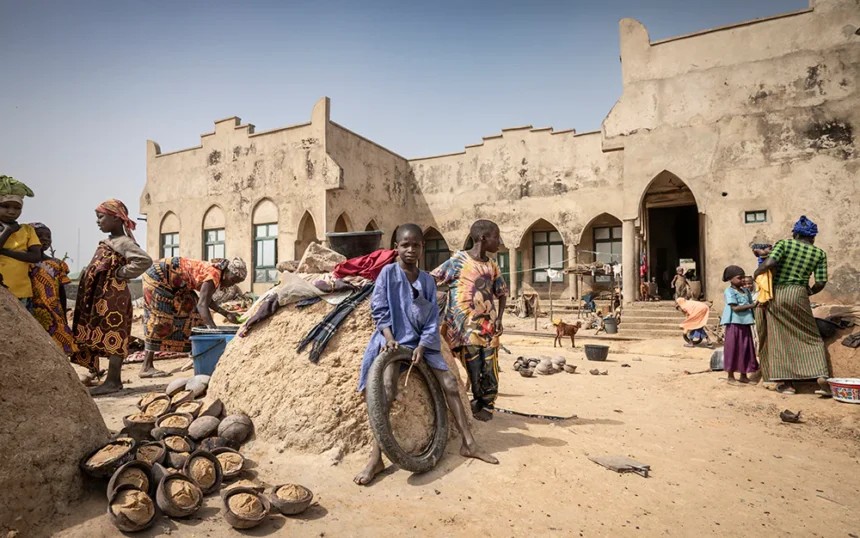
In November 1929, a colonial agent named Mark Emeruwa walked into the compound of a widow in Oloko, a town in southeastern Nigeria. His task was straightforward by British administrative standards: count her goats, count her people, record her property for taxation. The widow, Nwanyeruwa, was not interested in cooperating. When Emeruwa grabbed her by the throat, she went straight to the nearest market square and told other women what had happened.
Within days, tens of thousands of women from six ethnic groups — Igbo, Ibibio, Ogoni, Andoni, Bonny, and Opobo — had organised a revolt that spread across the Owerri and Calabar provinces. They marched. They sang protest songs. They surrounded native courts and the homes of warrant chiefs. They wanted the colonial tax extension reversed, and they wanted the corrupt chiefs removed. The British called it the Aba Women’s Riots. The Igbo called it Ogu Umunwanyi — the Women’s War. Historians have since called it the most serious challenge to British rule in the history of the Nigerian colony.
What drove those women to mobilise was not ideological fury alone. It was economic. A worldwide depression had crashed the price of palm oil, which was the spine of the southeastern Nigerian economy. Colonial demands for forced labour continued unabated. Newly imposed market tolls, school fees, and levies were bleeding traders dry. These women were not pamphlet-waving agitators. They were market women, farmers, and traders who had built their livelihoods stall by stall, crop by crop. What the British wanted to tax was not abstract wealth. It was the labour of women who had been working since before sunrise for their entire adult lives. The resistance they mounted was not just about dignity. It was about the right to keep the proceeds of your own hustle.
That tension — between a people who work ceaselessly and a system that takes without giving back — is the oldest story in Nigeria. It is also the story of hustle culture.
Before It Had a Name
Hustle as an idea is not Nigerian in origin. The word itself traces back to a Dutch verb, husselen, meaning to shake or toss, and entered English as a description of forceful effort. By the time it crossed the Atlantic and settled into American vernacular, it had picked up associations with urgency, grind, and the grey ethics of getting ahead by any means available. What happened in Nigeria is that the word got re-baptised. When Warri pidgin speakers folded it into their own inflection and comedians ran with the energy of it, hustle stopped being a borrowed concept and became something fiercer and more specific. In Nigerian usage, hustle does not mean diligence. Diligence is tame. Diligence expects a pat on the back at the end. The Nigerian hustle exists in the absence of guarantees. It is what you do when the structure that is supposed to support you has never shown up.
The pre-colonial record shows that the grounds for this had long been prepared. The Hausa market towns of Kano and Katsina were centres of sophisticated trade in textiles, grains, and livestock centuries before a British flag arrived. The Igbo of Onitsha and the Kanem-Bornu empire were embedded in vast commercial networks. Trade was not a supplement to life in much of what became Nigeria. It was life. When colonialism arrived, it did not find a passive population waiting to be given economic purpose. It found active traders and farmers whose markets it proceeded to restructure, tax, and subordinate to European commercial interests.
The British administration’s approach to Nigeria’s markets was, by design, extractive. Indigenous market systems that had governed their own logic for generations were forced to integrate into a global economy not on their own terms but on colonial ones. Local traders faced competition from European imports that they could not match. The taxes Nwanyeruwa and tens of thousands of others resisted in 1929 were not an anomaly. They were the system was working as intended. What the Women’s War showed was that the people subjected to this system would not simply absorb it. They would find ways to push back, to survive, to keep trading.
That survival instinct, passed down through generations, is the original architecture of what Nigerians today call hustle culture.
What Independence Did and Did Not Fix
Nigeria became independent in 1960, and for a moment the optimism was genuine. The country had oil. It had educated citizens. It had cultural prestige and geographic scale. The post-independence decade felt, in certain circles, like the beginning of something. Then came the civil war, military coups, the oil boom that produced elites and not infrastructure, and structural adjustment programs in the 1980s that the International Monetary Fund prescribed and which stripped whatever social scaffolding the state had managed to build. Public services deteriorated. Education funding collapsed. Employment in the formal sector shrank. The naira fell.

What replaced the state was ingenuity. Where electricity was unavailable, generators appeared. Where banks were inaccessible, informal lending circles, the ajo and esusu systems, kept money moving. Where roads were bad, okada riders built an entire informal transport economy. The informal economy did not emerge because Nigerians were unable to imagine something better. It emerged because something better was not on offer and people needed to eat. By the time the 21st century arrived, the informal sector accounted for the overwhelming majority of Nigerian employment. A 2025 report placed self-employment at roughly 85.6 per cent of the Nigerian workforce, with informal jobs constituting as much as 93 per cent of all employment in the country.
This is the economic substrate on which hustle culture grew. It did not grow from ambition alone. It grew from the absence of a floor.
The Grammar of the Grind
To understand how deep hustle culture runs in contemporary Nigeria, you have to understand how completely it has colonised the language of aspiration. Motivational content on Nigerian social media is a genre unto itself, and its dominant message is not balance or self-care. It is relentlessness. Wake up at 4 a.m. Sleep is a luxury you earn later. The man sleeping eight hours is losing to the man sleeping four. Productivity is the only currency worth accumulating. The content is not fringe. It is mainstream, shared in family WhatsApp groups and LinkedIn posts and Instagram reels watched by millions. Nigerian hustle culture has transformed the side hustle from supplementary income into a supposed requirement for basic respect and financial security.

There is a theological dimension to it too. Nigerian Christianity and Islam, both in their most popular forms, have long made common cause with the prosperity ethic. The sermon and the side hustle often speak the same language. God rewards effort. Faith without works is dead. The implication is that poverty is a failure of spiritual discipline as much as economic circumstance, which makes the act of grinding not just practical but morally necessary. To rest without having secured enough is to be found lacking by both God and your peers.
The social reinforcement is relentless. Families compare children. The neighbourhood watches who drives what. Owning a house before 35 is treated as baseline decency in some communities. The pressure to have three income streams is so entrenched that civil servants now run side businesses, bank employees manage e-commerce stores during lunch breaks, and lecturers drive ride-hailing cars after hours. One account captured in a 2026 essay on modern Nigerian work culture put it plainly: “I have three sources of income. One job stopped being enough because the income wasn’t predictable. I work from morning till night, sometimes only taking a one-hour nap.” The speaker was not describing a temporary grind toward a goal. They were describing Tuesday.
The Cost Nobody Posts About
A 2023 survey by the African Polling Institute found that 62 per cent of Nigerian workers felt overwhelmed every week. Only 7 per cent had access to any form of workplace mental health resources. Between 25 and 30 per cent of Nigerians will experience a mental illness in their lifetime, but only one in ten receives professional care. The funding gap is not accidental. A country that teaches its citizens to treat rest as weakness will not prioritise the infrastructure for healing.
Lagos-based psychologist Dr Oluchi Ibe captured it with a precision that should make people stop: “Most of my clients are not dealing with trauma from their past. They are dealing with trauma from their jobs.”
The psychic cost of hustle culture in Nigeria is not abstract. It shows up in the rising rates of anxiety and depression among young Nigerians. It shows up in the phenomenon of burnout being openly discussed in a way it was not a decade ago. It shows up in the Japa wave, the mass emigration of skilled Nigerians to Europe, North America, and elsewhere, which at its core is not just about seeking better pay. It is about seeking a life that does not require you to run constantly just to stay in place. The youth unemployment crisis compounds everything. The official rate of 4.3 per cent reported by the National Bureau of Statistics in 2024 is widely contested because it now counts anyone working one hour per week as employed. Afrobarometer’s figures are considerably grimmer. When the economy cannot absorb young people in meaningful work, hustle culture stops being a choice and becomes the only option available.
There is a growing movement that has begun to articulate what feels like a counter-position. The “soft life” conversation, which picked up serious momentum among Nigerian millennials and Gen Z, is not a demand for laziness. It is a demand for a life where working has diminishing returns that are actually visible. It is the insistence that rest is not the enemy of ambition. A viral post by social media figure Hauwa Lawal captured the sentiment concisely, arguing that Nigerians have been systematically cheated out of a basic ease of living, that the thought of hustle is so constant it never really leaves. The post resonated because millions of people recognised the description of their own heads.
The Difference Between Hustle and Being Hustled
There is a version of the Nigerian hustle that deserves genuine respect. The Aba market woman who rebuilt her business from scratch after the Women’s War. The first-generation Lagos migrant who turned a single trade into a family business across three decades. The tech founder in Yaba who built a fintech product that now moves real money for real people across the continent. These stories are not mythological. They are everywhere, and they represent something real about what Nigerians are capable of doing under conditions that would dismantle people raised in more stable environments.
But hustle culture in its current form goes beyond celebrating that capability. It has crossed into demanding it as the price of basic dignity. When the narrative insists that any Nigerian who has not multiplied their income streams is not serious about life, it is not describing ambition. It is pathologising rest. When grinding becomes an identity rather than a strategy, the question worth asking is who benefits from a population that never pauses to demand more from the systems that govern their lives.
The women who marched in 1929 were hustlers in every meaningful sense of the word. They had built their livelihoods through relentless daily labour, and when a colonial system tried to take what they had earned, they organised and fought back. What distinguished them was not just that they worked hard. It was that they knew the difference between the fruits of their own labour and what was being extracted from them by a system that offered nothing in return. They directed their energy not only inward toward personal survival but outward toward structural accountability.
That distinction has never been more important than it is now. Hustle culture in Nigeria will not become something healthier by teaching people to work less. It will only change when the country begins to build the conditions under which working hard might actually be enough.
Hustle was never the problem. The problem is that a country has made it the only answer.