





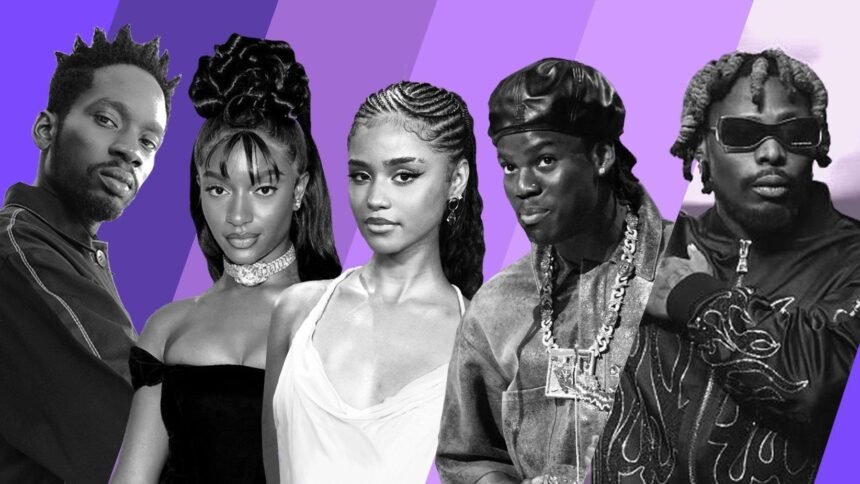
Over the past decade, Afrobeats has emerged as a growing genre in the global music industry. It is the most dominant pop sound on the African continent, catering to the youngest continent in the world with about 200 million Africans in the diaspora. Thanks to the power of social media, which served as a cultural accelerant, and the rise of music streaming, which erased the geographic borders that limited its reach and helped the genre connect to a global audience, Afrobeats quickly became Africa’s biggest and most influential cultural export.
Billboard hits, Grammy wins, and record-breaking tours have followed, with Nigerian artists attaining levels of pop success that position them as peers as well as direct competitors to their Western counterparts. But if Afrobeats intends to maintain its global standing, then it must be ready to evolve alongside the global music industry as it shapes its future. The global music business is preparing for its next shift, and Afrobeats must be prepared to evolve alongside it.
There has been an ongoing rift between major labels, indie labels and artists in recent years regarding how low streaming revenue is. In 2022, the Union of Musicians and Allied Workers urged Spotify to raise its per-stream royalties. They claimed the poor per-stream royalties make it almost impossible for emerging artists to break even. This confirms Lucas Emeodi of Speed Plug Promotions’ claim that an estimated ₦25–30 million is required to market a single in Nigeria. citing rates that make it difficult for artists and labels to recoup marketing costs, even with a solid 7 million Spotify streams, which, by the way, are quite difficult to come by. In 2014, Taylor Swift pulled her entire catalogue from Spotify, using her influence to protest and negotiate better terms.
Spotify CEO Daniel Ek commented on superfans and the likelihood of Spotify going in that direction in 2024. Though he didn’t confirm or deny if this strategic play is in the works, it only tells us how competitive the superfan industry is becoming, as it’s making streaming giants pay attention.
Has any African artist tried selling to fans directly?
The answer is simply yes. In 2023, Nigerian singer Mannywellz claimed he does not feel that distributing songs to traditional streaming platforms like Spotify, Apple Music, etc., favours the artist in any way. The R&B singer questioned the model and threatened to pull his catalogue from these platforms to release his music directly to fans. His bold move was met with a lot of mixed reactions.
While Nigerian hip-hop icon Sasha P joined EVEN in 2024 as an Artist Relations-Afrobeats, and hip-hop star MI Abaga became the first Nigerian artist to pre-release a single exclusively on EVEN in 2025. The song titled Mr Fantastic is the first single from his upcoming THE WOLF album.
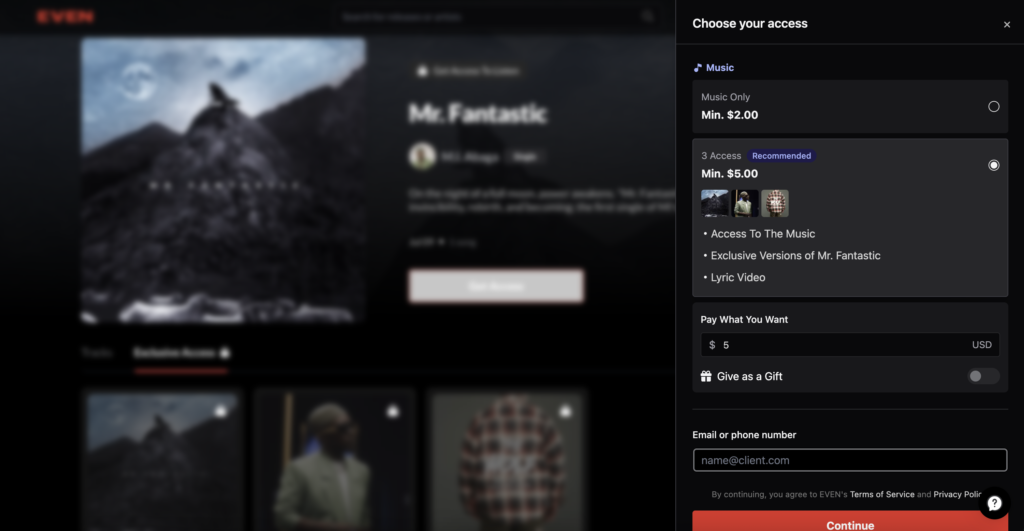
The song is priced at $2 and was previously sold for $3.27 for early access, while access to the music, exclusive versions of the song, and the lyrics video is sold at $5.
Why Universal Music Group partnered with EVEN
This past week, Universal Music Group announced it had struck a new multi-year agreement with superfan platform EVEN. EVEN, established in 2022 by Mag Rodriguez, is a platform that helps artists sell their music and exclusive content directly to their biggest fans. The platform has been used by several notable artists, including J. Cole, Omarion, Hit-Boy, Brent Faiyaz, Wale and Chance the Rapper, to navigate direct-to-fan sales and campaigns.
What this means is that UMG artists can now use EVEN to sell directly to fans and monetise their most engaged supporters upfront. Artists can now offer early access to music, exclusive content, physical albums, merch and private fan communities. This also means artists can now sell their music directly to fans instead of relying solely on digital streaming platforms like Spotify and Apple Music.
This isn’t a one-off. Universal Music Group has made concerted efforts to build infrastructure around fan communities, live experiences, and exclusive drops. In January 2026, the global music powerhouse announced it had acquired a minority stake in superfan platform Stationhead. Stationhead is a platform that allows artists and fans to listen, broadcast, and interact live together. Notable artists like Cardi B and Camila Cabello have hosted global listening parties on the platform.
Universal Music’s partnership with EVEN and Stationhead comes two years after the organisation announced it had invested in the South Korea-based global fan community platform, Weverse. Like EVEN and Stationhead, Weverse connects artists and fans through official communities and allows artists to sell exclusive media content and merch directly to fans. For many K-pop artists, including Seventeen, Tomorrow X Together, and BLACKPINK, Weverse serves as a central digital ecosystem.
In his annual New Year memo to UMG staff, Universal Music Group Chairman and CEO Sir Lucian Grainge revealed that superfan monetisation is a strategic priority for 2026, and these moves only reveal that UMG is betting on D2C to become a significant driver of revenue and is aggressively building the infrastructure to take early advantage.
Their competition is not sitting idle either. In 2024, Warner Music Group CEO Robert Kyncl revealed at the Web Summit tech conference in Doha, Qatar, that WMG is building its own superfan app. This establishes that major labels are investing heavily in superfan platforms and D2C is being formalised across the global music industry.
The emergence of platforms like [Untitled] and Vault.Fm further underscores the rising influence of D2C in the music industry.
Why does this matter to Afrobeats?
As mentioned earlier, the rise of music streaming played a crucial role in the explosion of Afrobeats. Thanks to streaming platforms like Spotify, Apple Music, and YouTube, Afrobeats artists were able to easily reach fans across the world, as streaming platforms enabled discovery through playlists and made their catalogues instantly accessible to a global audience.
However, the revenue structure for Afrobeats artists remains fragile, as they still rely heavily on streaming income (which depends largely on how well their music performs outside Nigeria, as streaming revenue from Nigeria remains low per stream) in addition to revenue generated from shows and brand deals. With major labels like UMG making moves to operationalise fanbases as infrastructure, it’s obvious this is not just a global trend but a structural shift in revenue generation and fan engagement.
D2C platforms allow artists to monetise their core fanbase through exclusive content, early access, merchandise, and community interaction instead of being overly reliant on streaming revenue. This allows artists to add stability to their revenue model and generate revenue outside traditional revenue sources.
This also ensures that Afrobeats artists have more control, more data, and more money from their core fans and depend less on DSP algorithms while providing their fans with more exclusives, more access and more community experiences. This model allows an Afrobeats artist to put their fanbases to much more effective use, converting them from casual fans (and online nuisances) into paying superfans.
Using D2C platforms can also contribute significantly to Nigerian artists succeeding on the Billboard charts. EVEN, for example, reports album sales to Luminate for Billboard chart eligibility. EVEN reported that the campaign around J. Cole’s 2014 Forest Hills Drive helped the album climb back into the Billboard Top 15, ten years after it first came out. The pre-release strategy for his latest album The Fall-Off also deployed similar tools to engage fans ahead of its official release, resulting in a number one debut on the Billboard 200. For Nigerian artists, platforms like EVEN enhance their chances of charting success.
Will the direct-to-fan model of superfan apps sell in Nigeria?
The capacity of the average Nigerian fan to pay for exclusivity may prove to be an issue thanks to the harsh economic realities of Nigeria. The average Nigerian music fan has very limited disposable income and struggles with subscription fatigue, often accessing music through ad-supported tiers on platforms like Audiomack, Boomplay and Spotify.
For example, the median salary for the average worker in Lagos sits at approximately ₦60,000 per month, with 7% of workers in the city earning more than ₦200,000. When food, transport, and housing take the bulk of that income, asking the same person to pay ₦10,000 for exclusive music content is asking them to spend over 10% of their monthly earnings, and that might prove too tough.
This unfortunate reality makes the diaspora audience an immediate target for such premium campaigns and high-cost offerings. The Nigerian diaspora is estimated at approximately 17 million people globally, with the largest concentration in the United States, the United Kingdom, and Canada. They already demonstrate their economic engagement with home, as Nigeria received over $25 billion in remittances in 2024. This confirms that the diaspora both have money and are willing to spend it on things that matter to them. The question is whether the industry can build the infrastructure to convert that loyalty into monetisable fan relationships.
There are also fans within Nigeria with real disposable income. This means a tiered model could serve both the premium local fan and the mass local fan. Overall, Afrobeats artists can prioritise high-value markets abroad while offering affordable community offerings locally. The goal is to build an ecosystem that works globally and domestically. Afrobeats artists who understand what their fans can pay and structure their D2C offerings accordingly will eventually win.
The superfan era has already arrived, and the global music industry is adjusting. Afrobeats has achieved global acceptance, but the next phase of growth and sustainability depends on premium monetisation and community infrastructure. It’s up to the Nigerian music industry and its best thinkers to figure out concrete ways Afrobeats artists can leverage D2C and develop models that balance fan engagement, affordability, and sustainable revenue generation to suit our local context. The global music industry is entering its superfan era, and Afrobeats can’t ignore it.