





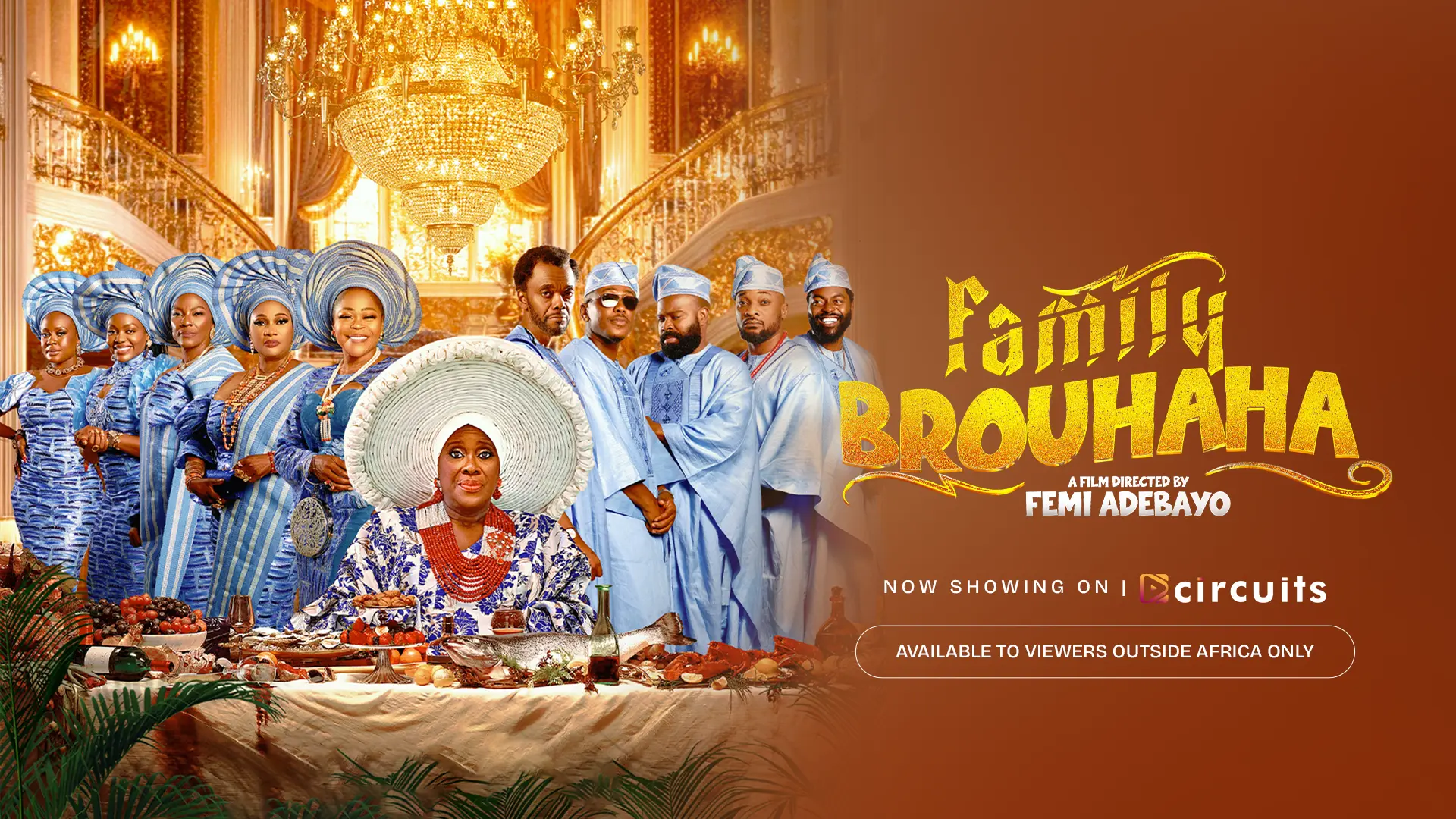
Family Brouhaha, a lavish production by Beryl Hill Studios under the direction of Femi Adebayo, plunges into the heart of privilege and entitlement within the Braimoh dynasty, a family of wealth, indulgence, and crumbling values.
At the centre of the film is the matriarch, the formidable Mrs Braimoh, whose decision to freeze the family’s access to the fortune they’ve long taken for granted triggers a maelstrom of chaos as the clan converges at her seventy‑year milestone celebration.
Plot
The Braimoh family is rooted in old money, cocoa plantations, and generational entitlement. The patriarch of the family is long gone, leaving the sharp, calculating matriarch, Mrs Braimoh, to manage not just the family estate but also the emotional debris of her spoilt children and their children.
The family tree begins with her three adult children: Mofe, the first son; Abonlanle, the daughter; and Abiola, the last son and child. Mofe has two sons, one married, the other engaged, both of whom are soaked in privilege but riddled with personal flaws. Abonlanle also has two sons, both unmarried, though one lives with Down Syndrome and is often pushed to the sidelines of the family dynamic. Abiola, on the other hand, has two daughters, both stylish and sharp, and unknowingly dating the same man.
The Braimoh children have grown up bathing in luxury. From jet-set shopping sprees to platinum-wrapped opulence, their lifestyle was secured through the family’s booming cocoa empire. Yet, everything spirals when Mrs Braimoh pulls the plug: she freezes all family accounts and calls for a mandatory family gathering, which also coincides with her 70th birthday. The condition? Show up and shape up, or remain cut off.
As expected, what follows is not a warm reunion but a combative, ego-fuelled convergence. The children arrive at their mother’s house, bringing along their overbearing spouses, entitled kids, unresolved traumas, and repressed rivalry. Mrs Braimoh’s sister-in-law, the late patriarch’s own sister, plays co-pilot to the matriarch’s firm resolve, helping her navigate the storm that comes with hosting the most dysfunctional family in Nigeria under one roof.
Mofe, the firstborn, lives under the thumb of his manipulative wife, who constantly eggs him on with statements like, “You’re the first son, act like it!” She’s power-hungry and obsessed with inheritance. Meanwhile, Mofe is constantly at odds with Abiola, his younger brother. Their tension is visible, loud, and unrelenting. Their wives, too, are locked in a cold war of superiority and subtle digs. One attempt to host a family dinner ends in absolute chaos, with insults flying, secrets cracking, and no food eaten.
Mofe’s married son finds himself under pressure. His wife, who has struggled with fertility, is emotionally battered by her mother-in-law (Mofe’s wife), who shows zero compassion. Although standing by his wife, Shola shamelessly cheats on her: boldly and publicly. In fact, his infidelity is so out in the open that it almost becomes part of his character description, a reckless display of entitlement and disregard for decency.

Then comes Abiola, perhaps the most emotionally complex sibling. Though outwardly composed and seemingly above the fray, he carries buried trauma that erupts in the presence of a therapist hired by Mrs Braimoh in a desperate attempt to restore family unity. During one of the therapy sessions, Abiola bravely reveals a dark secret: he was sexually assaulted by the family’s domestic staff as a child. When he attempted to confide in Mofe, his older brother, he was cruelly dismissed; a dismissal that laid the foundation for decades of resentment. The revelation shifts the entire emotional gravity of the film, showing that beneath the designer clothes and luxury cars lies emotional rot.
Abonlanle’s own marriage isn’t picture-perfect either. Though her husband appears to be the calm anchor of their relationship, Abonlanle is secretly cheating. In a shocking twist, she sneaks off to be with his lover even during his mother’s birthday week. There’s no regard for boundaries, emotional or spatial. Her two daughters are being played simultaneously by the same conman who claims to be a twin. In reality, this man is a scam artist whose mission is to drain the family’s trust fund. He plays both sisters expertly, under different identities. The real gag? He’s also involved with the woman Mofe’s engaged son is planning to marry. The interwoven mess of romantic entanglements is less a love triangle and more a money-obsessed circus.
Meanwhile, the scammers, including the fake twin, start to unravel. At the birthday party, someone overhears a heated argument between the fraudster lovers. Their conversation reveals everything: the lies, the scam, the fake twin, and the plan to extract money from the trust. But before the truth can be properly addressed, a fight breaks out between Shola and Abiola. Their long-standing beef explodes publicly. Insults turn physical, and in a tragic, climactic moment, the scuffle results in an accidental death, right in the middle of the birthday celebration.
Amidst all the grief and madness, the family regroups for the “real” event: the reading of the will. Before the birthday, the family had bribed the family lawyer in hopes of manipulating the inheritance in their favour. But Mrs Braimoh, wise and always two steps ahead, had already changed the lawyer without their knowledge.
During the official ceremony, a video plays. In it, Mrs Braimoh calmly explains that the fortune, the properties, the accounts, and everything associated with the Bermo legacy would be handed over to Nasir, the young son of Abonlanle. Up until this point, Nasir had been portrayed as having Down Syndrome and being mute, always sidelined, barely acknowledged. But as the camera pans, in a breathtaking twist, Nasir walks confidently forward, speaks clearly, and ends the movie with a chilling word: “Checkmate.”
Cast
Family Brouhaha features Joke Silver, Tina Mba, Yemi Shodimu, Wale Ojo, Jaiye Kuti, Shaffy Bello, Ifeanyi Kalu, Dezar the Great, Gabriel Afolayan, Ada and Timini Egbuson
Language
The movie was predominantly in the English language.
Final take
If there’s one thing Family Brouhaha managed to achieve, it’s proving that even with a big budget, a visually rich setting, and a star-studded cast, a movie can still fall flat on its face. From the very beginning, it’s hard to pinpoint exactly what the film is trying to be: a drama? A comedy? A family saga? An emotional thriller? Whatever the answer, the result is a confused, overstretched narrative that seems to be everywhere and nowhere at once.

And let’s talk about the attempt at humour. Or rather, the lack of it. For a film that markets itself with a comic undertone, it was, in no uncertain terms, painfully boring. Not a chuckle, not a smirk, just dry dialogue and scenes that drag like a sermon you didn’t sign up for. It was one long loop of shouting matches and overacted quarrels. And somehow, even those were unconvincing.
The aesthetics of wealth they tried to portray? A forced flex. The whole rich-family-meets-Naija-chaos vibe didn’t land because, frankly, it was hollow. It lacked texture, authenticity, or even enough visual storytelling to compensate for the poor writing.
Now, let’s address the film’s attempt at emotional depth. That pivotal moment where one of the characters reveals childhood sexual abuse during therapy could have been powerful if it hadn’t been so random. It came out of nowhere. No emotional cues, no buildup, no moment of shared revelation. Just an abrupt insert, like someone cut and pasted a dramatic monologue into the wrong script. It didn’t shift the character’s arc, it didn’t alter any relationships, and worst of all, no one in the family even reacts. So, what was the point? If you’re going to touch on trauma, and such a sensitive one at that, it has to matter. It has to ripple through the story.
The most glaring flaw? It completely lacked a backstory. And not just in the sense of a few missing details here and there; there is absolutely no foundation laid for who these people are, where they’re coming from, or why we should even care.
And that’s what the film is at its core: a disjointed collection of subplots that don’t fit together. Every 10 minutes, a new mini-story is introduced, and none of them are properly resolved or connected. It felt like the writers kept throwing ingredients into a pot without knowing what dish they were cooking. The result? A cinematic stew with too much pepper, no salt, and definitely no meat.
Watching this film was not only disappointing, but it was also unsettling. The pacing was erratic. The scenes felt stitched together. Characters were reduced to stereotypes. And the whole experience felt less like a film and more like a rage bait; something designed to frustrate the viewer rather than entertain or enlighten them.