







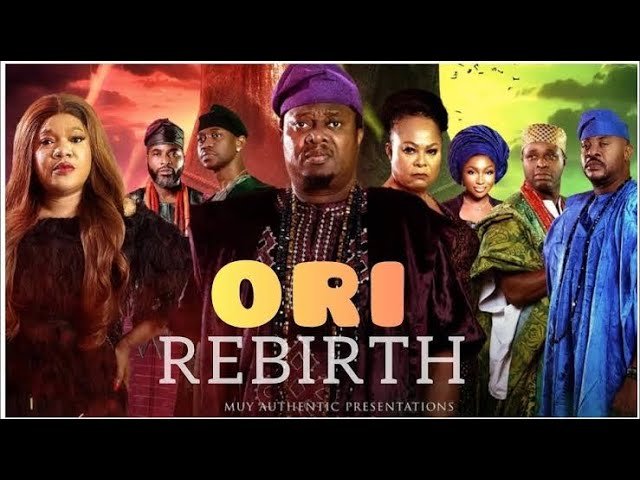
Back in 2004, Muyiwa Ademola introduced Ori, a film that boldly stepped into the world of Yoruba metaphysics, grappling with destiny, fate, and the unseen forces that shape human lives, long before spiritual thrillers became a familiar space in Nollywood.
Fast forward two decades, and Ori Rebirth returns, not just as a continuation, but as an attempt to stretch that original vision into a more contemporary setting. This time, the sacred and the modern collide, where age-old spiritual battles exist alongside ringing smartphones and polished city life.
What unfolds is a film deeply rooted in themes of supernatural power struggles and family loyalty, but one that also carries a noticeable layer of narrative chaos.
Plot
The film centres on Bisade, a man caught in a haunting struggle where his destiny seems to both protect and destroy him. Married into the wealthy and powerful Fernandez family, Bisade appears to have everything: status, comfort, and influence. The family is led by the formidable matriarch, Yeye Fernandez, alongside her children: two daughters and two sons who recklessly indulge in their late father’s fortune.
Beneath this glamorous surface, however, Bisade’s life is deeply unsettled. He is plagued by recurring nightmares; visions of falling, being trapped, and impending doom, subtle warnings of a fate closing in on him.
Unbeknownst to him, Yeye Fernandez has already set a sinister plan in motion. In a desperate attempt to protect her own children from a looming spiritual curse tied to her late husband’s past, she conspires with ritualists to sacrifice Bisade. They prepare a charmed bead meant to bind or ultimately end his destiny.
On the night of Bisade and his wife’s anniversary celebration, the tension reaches a peak. During the festivities, a musician suddenly falls into a trance and begins to sing cryptic warnings about danger ahead. Alarmed, Yeye quickly silences him, determined to keep her plans hidden.
That same night, under the guise of a spiritual prayer for fertility, she urgently calls Bisade back from Abuja. But fate intervenes, on his return, the private jet crashes. Though the pilots survive, Bisade disappears without a trace and is presumed dead.
Years later, the truth unfolds. Bisade is alive, but living a completely different life in a remote village, with no memory of his past. He has built a new family, with a wife and son (even an unborn child), far removed from the world he once knew. Meanwhile, back in the Fernandez household, Yeye grows increasingly desperate. Convinced that the ritual failed because Bisade is still alive, she seeks new spiritual means to complete the sacrifice, believing his death is the only way to save her children.
As both worlds begin to collide, Bisade’s village wife engages in a fierce spiritual battle to protect him. This confrontation ultimately triggers the return of his memories, forcing him to confront the truth of who he is, and the dark forces that have been hunting him.
What follows is a tense clash between past and present: legal battles, emotional confrontations, and spiritual warfare, as Bisade is torn between two lives and two identities. At its core, the film explores sacrifice, destiny, and the devastating lengths a mother will go to protect her own, no matter the cost.
Cast
Toyin Abraham delivers a deeply affecting portrayal of Temidun, carrying the emotional weight of the film with striking sincerity. Her performance feels lived-in; her grief, hope, and spiritual endurance come through in a way that feels raw rather than staged, drawing the audience into her pain.
Sola Sobowale, as the formidable matriarch, brings her usual commanding presence to the screen. She embodies a woman driven by fear – fear of legacy, of loss, of generational consequences, and channels it into decisions that are as devastating as they are understandable. Interestingly, she and Toyin never share screen time, yet their parallel arcs mirror each other powerfully: two mothers, each shaped by love, but expressing it in radically different, and equally destructive or protective ways.

Muyiwa Ademola returns to his role with noticeable restraint. Rather than over-dramatizing Bisade’s internal conflict, he allows the character to unravel quietly, letting the weight of his circumstances do most of the work. It’s a measured performance that adds a layer of realism to an otherwise chaotic narrative.
Supporting performances are more of a mixed bag. Omowunmi Dada brings a grounded presence to Olapeju, while the young actor playing Eniafe holds his own with a natural ease. However, both characters suffer from limited development, making their performances feel underutilized.
On the other hand, appearances from Femi Adebayo, Odunlade Adekola, and Lateef Adedimeji come across as more ornamental than essential. While their presence adds star power, their roles lack narrative significance, feeling more like strategic casting choices than integral parts of the story.
Despite its uneven storytelling, the film finds its footing in the strength of its performances. Ultimately, it’s the actors, more than the script that give the film its emotional pulse.
Language
Ori Rebirth was primarily performed in the Yoruba language.
Final take
Ori Rebirth clearly came to impress, at least visually and to be fair, it delivers on that front. The film leans heavily into its aesthetic, with village scenes that feel lush, immersive, and almost hypnotic. You can practically smell the dust, feel the silence, and sense that something spiritual is always lurking just beneath the surface. And then there’s the soundtrack, arguably the film’s most reliable narrator. At several points, the music steps in like, “Don’t worry, I’ll explain,” doing the emotional heavy lifting the dialogue sometimes abandons. In fact, during the more intense spiritual encounters, the score doesn’t just support the story, it becomes the story.
The film sets out to grapple with big, weighty ideas: destiny versus free will, ancestral consequences, spiritual inheritance. Ambitious? Absolutely. Successful? Well, sometimes. It’s a classic case of biting off more than it can chew, then chewing very slowly. The themes are rich and culturally grounded, but the execution often feels like the film is trying to explain a deep spiritual thesis while also racing against its own confusion.

One of its biggest struggles is tone. The film can’t quite decide what it wants to be, mystical thriller, family drama, or spiritual epic, so it attempts all three at once, often within the same scene. The result? Emotional whiplash. Moments that should land with impact are cut short by abrupt transitions, while others overstay their welcome, padded with dialogue that circles the point without ever quite arriving. You’ll find yourself thinking, “Yes, we get it,” while the scene insists, “No, you really don’t.”
Then there’s the pacing, over two hours of it. And you feel every minute. The film stretches itself thin, lingering where it shouldn’t and rushing where it absolutely needs to breathe. Ironically, for a story about destiny, it feels like the editing had none. Scenes jump, timelines blur, and before you can settle into one moment, the film has already moved on, no warning, no transition, just vibes.
To make matters trickier, Ori Rebirth assumes you’ve done your homework. As a sequel to Ori (2004), it doesn’t exactly hold your hand. If you haven’t seen the original, you’re essentially dropped into the deep end of a spiritual ocean with no floaties. Characters, callbacks, and plot threads appear with the confidence of inside jokes, leaving new viewers trying to piece things together like a puzzle with missing edges.
Time itself becomes, negotiable. It’s often unclear how long Bisade has been gone or how he seamlessly built a whole new life in the village. And when his memories finally return, it happens so abruptly it almost feels like someone flipped a switch backstage. One minute he’s locked in a spiritual battle, the next, boom, full clarity. No buildup, no transition, just instant enlightenment. If only life worked that way.
The storytelling moves with urgency, but not always with clarity. It jumps across timelines and emotional beats without proper grounding, making it hard to stay fully connected. Characters drift in and out, sometimes feeling more like spiritual cameos than fully realized people. The film aims for mystery, but often lands in confusion, even for viewers paying close attention. You’re left wondering, “Did I skip a scene or what?”
Still, for all its chaos, Ori Rebirth isn’t without merit. Beneath the tangled narrative is a film that dares to explore complex spiritual ideas and emotional stakes. It may not always make sense, but it definitely makes an impression.