




Wondering how Ghana got its name from the ancient Ghana Empire (also called Wagadou), a powerful West African kingdom that thrived from approximately 300 to 1235 CE? The word “Ghana” comes from the Soninke language, meaning “Warrior King” or “war chief”—the royal title given to the empire’s rulers. When Dr. Kwame Nkrumah led the Gold Coast to independence on March 6, 1957, he chose “Ghana” to honor this legendary empire and symbolize the strength, unity, and liberation of the newly independent nation.
The Ancient Ghana Empire: Origins of the Name
What Was the Ghana Empire?
The ancient Ghana Empire was one of West Africa’s most powerful medieval kingdoms, ruling from roughly 300 CE to 1235 CE. Located in present-day southeastern Mauritania and western Mali—hundreds of miles northwest of modern Ghana—this empire was a cornerstone of trans-Saharan trade and African civilization.
The empire was founded and ruled by the Soninke people, who called their kingdom “Wagadou,” meaning “place of herds.” However, they used a different term for their king: Ghana.
What Does “Ghana” Actually Mean?
The word “Ghana” originates from the Mande/Soninke language and translates to:
- “Warrior King” (primary meaning)
- “War Chief” (alternative translation)
- “King of Gold” (secondary meaning, reflecting the empire’s wealth)
This wasn’t just any title—it represented absolute authority, military prowess, and control over vast territories and lucrative trade routes. The Ghana commanded thousands of warriors and ruled over numerous tributary states.
By the 8th century CE, when Arab traders and historians began documenting West African kingdoms, they referred to the entire empire by its ruler’s title. The name “Ghana” spread throughout the Islamic world, cementing the empire’s reputation as a land of power and wealth.
The “Land of Gold” Legacy
Arab merchants called the Ghana Empire the “Land of Gold” for good reason. The empire’s strategic location between the gold-producing regions of West Africa and the salt mines of the Sahara made it fabulously wealthy.
The Ghana Empire controlled:
- Trans-Saharan trade routes connecting North Africa to sub-Saharan Africa
- Taxation of all goods passing through their territory
- Access to West Africa’s richest gold fields
- Trade in salt, ivory, copper, and slaves
The 11th-century Arab scholar Al-Bakri wrote accounts of the Ghana Empire’s extraordinary wealth, describing a king who owned a thousand horses, each sleeping on carpets with silken halters, and a nugget of gold so large that the king used it to tether his horse.
The Empire’s Decline and Fall
After centuries of prosperity, the Ghana Empire declined due to:
1. Almoravid Invasion (1076 CE) Muslim Berber warriors from North Africa captured the capital, Koumbi Saleh, disrupting trade networks and forcing religious conversion.
2. Loss of Trade Control As gold sources shifted southward and competing kingdoms emerged, Ghana’s economic dominance weakened.
3. Rise of the Mali Empire In 1203, the Susu kingdom conquered Ghana. By 1235, after the legendary leader Sundiata Keita defeated the Susu at the Battle of Kirina, the Ghana Empire was absorbed into the Mali Empire, ending its independence by 1240 CE.
Despite its fall over 700 years ago, the Ghana Empire’s legacy—and its powerful name—would eventually be revived on Africa’s Atlantic coast.
From Gold Coast to Ghana: The Colonial Chapter
Why Was It Called the “Gold Coast”?
When Portuguese explorers reached West Africa’s coast in 1471, they discovered vast gold resources and established trade relationships with coastal kingdoms. The Portuguese named the region “La Mina” (meaning “The Mine”) and later “Costa do Ouro” (Gold Coast).
In 1482, the Portuguese built Elmina Castle—the first permanent European structure in sub-Saharan Africa, which still stands today as a UNESCO World Heritage Site.
Over the following centuries, other European powers arrived:
- Dutch (1598)
- British (1600s)
- Danes (1650s)
- Swedes (1650s)
By the late 1800s, the British had consolidated control, and in 1874, the Gold Coast officially became a British Crown Colony.
Life Under Colonial Rule
The British colonial period (1874-1957) was marked by:
- Exploitation of natural resources (gold, timber, cocoa)
- Introduction of cocoa farming, which became a major export
- Limited educational opportunities for Africans
- Racial discrimination and economic inequality
- Suppression of traditional governance systems
However, this era also saw the rise of an educated African elite who would eventually lead the independence movement.
The Independence Movement and Choosing “Ghana”
The Push for Self-Governance
By the 1940s, calls for independence were growing louder across Africa. World War II had exposed the contradictions of fighting for freedom abroad while being denied it at home.
Key figures in Ghana’s independence movement:
- Dr. J.B. Danquah – Lawyer, scholar, and nationalist who co-founded the United Gold Coast Convention (UGCC) in 1947
- Dr. Kwame Nkrumah – Charismatic leader who later broke away to form the Convention People’s Party (CPP)
- Paa Grant – Wealthy merchant who funded nationalist activities
- Edward Akufo-Addo – Lawyer and politician (father of former president Nana Akufo-Addo)
The Name Debate
As independence approached, leaders debated what to name the new nation. The colonial name “Gold Coast” represented exploitation and foreign control—it had to go.
Who First Suggested “Ghana”?
The idea wasn’t new. Reverend J.B. Anaman first proposed the connection between the Gold Coast peoples and the ancient Ghana Empire in his 1895 book “The Gold Coast Guide.” He suggested that many ethnic groups in the colony traced their ancestry to the empire’s inhabitants.
Between 1907-1911, Reverend W.T. Balmer taught this theory at Achimota School, and it gained widespread acceptance. By the 1920s-1940s, the idea that Akan peoples had migrated from the ancient Ghana Empire region was commonly taught in schools.
J.B. Danquah’s Advocacy
Dr. Danquah, using Arabic and French historical texts, strongly promoted “Ghana” as the new nation’s name. However, critics argued that focusing on the Akan connection ignored the non-Akan peoples of the Northern Territories. The newspaper “West Africa” challenged Danquah, writing: “It appears Dr. Danquah’s view of nationhood does not extend to the Non-Akan population.”
Danquah initially proposed a compromise: “New Ghana.”
Nkrumah’s Decision
Kwame Nkrumah had already signaled his preference for “Ghana” when he founded the Ghana National College in 1948 after student protesters were dismissed from school. By the time independence approached, “Ghana” had become the clear choice.
March 6, 1957: Independence Day
At midnight on March 6, 1957, the Gold Coast, Ashanti, the Northern Territories, and British Togoland were unified as one independent nation: Ghana.
In his historic independence speech, Dr. Nkrumah declared:
“We take pride in the name Ghana, not out of romanticism, but as an inspiration for the future.”
He also proclaimed:
“Our independence is meaningless unless it is linked up with the total liberation of the African continent.”
Ghana became the first sub-Saharan African colony to gain independence, inspiring over 30 other African nations to follow suit in the 1960s—a period known as the “Year of Africa.”
Why “Ghana”? The Symbolism Behind the Name
Nkrumah and the independence leaders chose “Ghana” for several strategic and symbolic reasons:
1. Historical Prestige and African Pride
By adopting the name of a powerful ancient African empire, Ghana reclaimed African dignity and challenged colonial narratives that portrayed Africa as primitive and without history. The name announced to the world: “We are the inheritors of great civilizations.”
2. Unity Across Ethnic Lines
Unlike names tied to specific ethnic groups, “Ghana” represented a shared heritage that could unite the diverse peoples of the new nation—Akan, Ga, Ewe, Dagomba, and dozens of other groups.
3. The “Warrior King” Spirit
The meaning “Warrior King” symbolized:
- Strength and military prowess
- Resistance against colonialism
- Protection of sovereignty
- Leadership and courage
This resonated with a nation that had fought for its freedom.
4. Pan-African Vision
Nkrumah saw Ghana’s independence as the first step toward African unity. The name needed to carry weight and inspire other colonies to fight for their freedom. “Ghana” accomplished this—within a decade, the African independence movement swept the continent.
5. Rejection of Colonial Identity
“Gold Coast” represented:
- Economic exploitation (focus on extracting gold)
- Colonial perspective (Europeans naming African land)
- Subordinate status
“Ghana” represented:
- Self-determination
- African identity
- Independence and sovereignty
The Connection: Ancient Ghana vs. Modern Ghana
Are They the Same Place?
No. This is a common misconception. The ancient Ghana Empire and modern Ghana are geographically separate:
Ancient Ghana Empire:
- Located in present-day southeastern Mauritania and western Mali
- Approximately 500 miles (800 km) northwest of modern Ghana
- Capital: Koumbi Saleh (in modern Mali/Mauritania border region)
Modern Ghana:
- Located on West Africa’s Atlantic coast
- Borders: Côte d’Ivoire (west), Burkina Faso (north), Togo (east), Gulf of Guinea (south)
- Capital: Accra
So Why Use the Name?
The connection is based on:
1. Migration Theory Oral traditions and some historical evidence suggest that after the Ghana Empire fell (1235-1240 CE), survivors migrated southward. Some may have settled in the region that became modern Ghana.
2. Cultural and Ethnic Links Several ethnic groups in northern Ghana—particularly the Mamprussi, Dagomba, and some Akan subgroups—trace their origins to peoples connected with the ancient empire or the broader region.
3. Trade Network Continuity The gold trade that enriched the ancient Ghana Empire originated in the forest regions of modern Ghana. There were long-standing trade connections between the two areas.
4. Symbolic Connection Even if the direct ancestral link is debated, the symbolic connection is powerful. Ghana’s leaders wanted to associate the new nation with African greatness, power, and civilization.
Modern historians continue to debate the strength of the literal connection, but the symbolic importance of the name for nation-building was undeniable.
Ghana’s National Identity Today
What “Ghana” Means to Ghanaians
Today, the name “Ghana” carries multiple layers of meaning:
Historical Legacy – Connection to ancient African greatness and the “Warrior King” tradition
Independence Pride – Symbol of being the first sub-Saharan nation to break free from colonialism
National Unity – A name that transcends ethnic divisions and unites 30 million people
Pan-African Leadership – Representing Africa’s potential and inspiring continental liberation
Economic Aspiration – Echoing the “Land of Gold” legacy and Ghana’s natural wealth
National Symbols
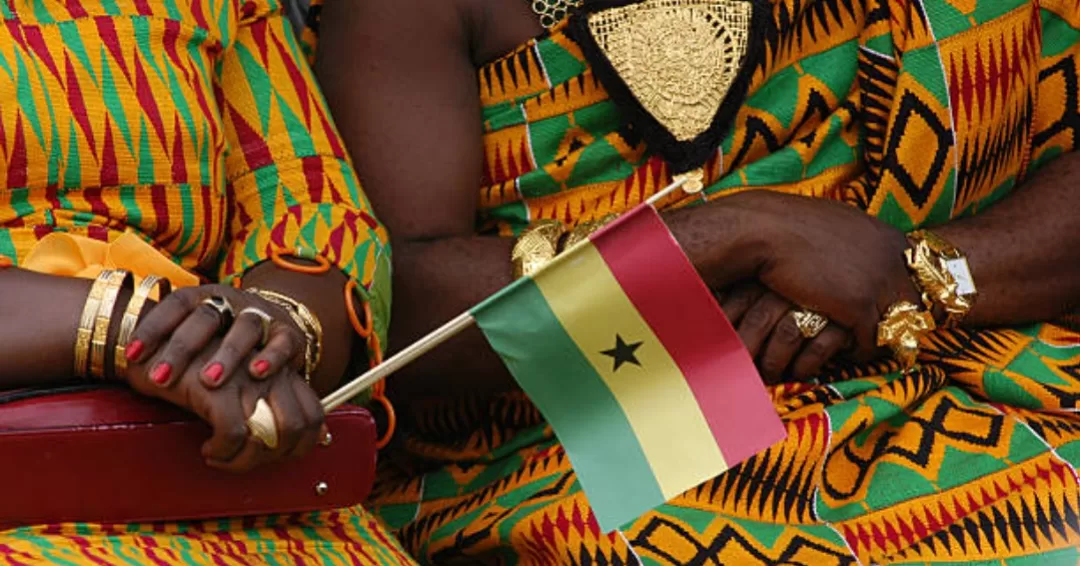
The symbolism extends to Ghana’s flag and emblems:
The Flag (Red, Gold, Green, Black Star):
- Red – Blood of those who fought for independence
- Gold – Mineral wealth and prosperity
- Green – Forests and natural resources
- Black Star – African emancipation and hope
The black star was inspired by Marcus Garvey’s Black Star Line and Pan-African movement.
The National Anthem opens with: “God bless our homeland Ghana, and make our nation great and strong; Bold to defend forever the cause of Freedom and of Right.”
Frequently Asked Questions
How did Ghana get the name?
Ghana got its name from the ancient Ghana Empire, a powerful West African kingdom that existed from 300-1235 CE. The word “Ghana” means “Warrior King” in the Soninke language. Dr. Kwame Nkrumah chose this name when the country gained independence in 1957 to replace the colonial name “Gold Coast” and to honor African heritage and strength.
Who gave the name Ghana to the country?
Dr. Kwame Nkrumah, Ghana’s first president and leader of the independence movement, officially gave the country the name “Ghana” on March 6, 1957. However, the idea was first suggested by Reverend J.B. Anaman in 1895 and later promoted by Dr. J.B. Danquah. Nkrumah made the final decision to adopt “Ghana” as the nation’s official name.
What does Ghana mean in Arabic?
Ghana doesn’t have a specific meaning in Arabic since it originates from the Soninke/Mande language, not Arabic. However, Arab traders and historians who documented the ancient Ghana Empire between the 8th-11th centuries used the word “Ghana” (غانا) as they heard it from the Soninke people. In their chronicles, they described it as the “Land of Gold.” The original meaning “Warrior King” comes from the Soninke language.
Why is it called “the Ghana”?
The country is actually called just “Ghana” or “the Republic of Ghana,” not “the Ghana.” However, when referring to the ancient empire, historians often say “the Ghana Empire” to distinguish it from the modern country. Additionally, because “Ghana” was originally a royal title meaning “Warrior King,” historical texts sometimes refer to the ruler as “the Ghana,” similar to how we say “the Pharaoh” or “the Emperor.”
What was Ghana before it was Ghana?
Before independence in 1957, the territory was called the “Gold Coast” under British colonial rule (1471-1957). The Portuguese first named it “La Mina” (The Mine) in 1471 due to its gold resources. Before European colonization, the area wasn’t a unified nation but consisted of various independent kingdoms including the powerful Ashanti Empire, Bonoman, Kingdom of Dagbon, Fante states, Ga kingdoms, and others. These kingdoms had their own names but no single unified name for the entire region.
How Ghana got its name in the Bible
Ghana’s name is not mentioned in the Bible. This is a common misconception. The Bible references Africa (particularly Egypt, Ethiopia/Cush, and Libya) but does not mention Ghana or West Africa specifically. Ghana’s name comes from the ancient Ghana Empire and the Soninke language, not biblical sources. The naming is purely historical and cultural, based on African heritage rather than religious texts.
How Ghana got its name in English
In English, “Ghana” comes from the ancient Ghana Empire’s royal title. The English translation of the Soninke word is “Warrior King” or “war chief.” English-speaking historians and scholars adopted the name from Arab and French historical texts documenting the ancient empire. At independence in 1957, “Ghana” was officially adopted in English to replace “Gold Coast.”
How Ghana got its name in Africa
Within Africa, Ghana’s name connects the modern nation to the ancient Ghana Empire (Wagadou). In Mande languages spoken across West Africa, “Ghana” means “Warrior King” and symbolizes pre-colonial African power, resistance against colonialism, and Pan-African unity. Ghana’s independence and name choice inspired over 30 African nations to seek liberation in the 1960s, making the name a symbol of African dignity and self-determination.
What is the full history of Ghana?
Ghana’s history spans over 6,000 years: Early settlements (4000 BCE-1000 CE) with Bronze Age communities; medieval kingdoms (1000-1500 CE) including Bonoman and Dagbon; European contact (1471-1874) with Portuguese arrival and transatlantic slave trade; British colonial period (1874-1957) as the Gold Coast; and modern independence (1957-present) beginning with Kwame Nkrumah’s leadership. Ghana became the first sub-Saharan African colony to gain independence on March 6, 1957.
How old is Ghana?
As an independent nation, Ghana is 68 years old (founded March 6, 1957, as of 2025). The territory has been inhabited for over 6,000 years since approximately 4000 BCE. The ancient Ghana Empire that gave the country its name existed for roughly 900-1,000 years (circa 300-1235 CE). Pre-colonial kingdoms like Bonoman and Dagbon date back over 1,000 years.
Where is Ghana?
Ghana is located in West Africa on the Gulf of Guinea and Atlantic Ocean. It borders Côte d’Ivoire to the west, Burkina Faso to the north, and Togo to the east. Ghana covers 239,567 square kilometers (about the size of the United Kingdom) and has a population of approximately 35 million. The capital and largest city is Accra, located on the southern coast.
What is Ghana’s religion?
Ghana is predominantly Christian (71%), with significant Muslim (18%) and traditional African religion (5%) populations. Christianity includes Pentecostal/Charismatic (28%), Protestant (18%), Catholic (13%), and other denominations. Islam is primarily Sunni, concentrated in northern regions. Ghana is known for exceptional religious tolerance and harmony, with the constitution guaranteeing religious freedom.
The history of Ghana before independence
Before independence in 1957, Ghana consisted of powerful pre-colonial kingdoms (11th-19th centuries) including the Ashanti Empire, Bonoman, and Kingdom of Dagbon. European contact began in 1471 with the Portuguese, leading to the Gold Coast name and transatlantic slave trade. British colonization (1874-1957) brought cocoa farming, limited development, and racial discrimination. The independence movement (1947-1957), led by Kwame Nkrumah and J.B. Danquah, culminated in Ghana becoming Africa’s first independent sub-Saharan nation on March 6, 1957.
Conclusion
The transformation from “Gold Coast” to “Ghana” represents far more than a name change—it’s a declaration of identity, pride, and self-determination. By choosing the name of a legendary African empire, Ghana’s founders connected their new nation to a heritage of power, wealth, and civilization that predated colonialism by centuries.
The name “Ghana”—meaning “Warrior King”—captures the spirit of a people who fought for their freedom and won. It honors the ancient Soninke rulers who commanded vast territories and controlled the flow of gold across the Sahara. It symbolizes the unity of diverse ethnic groups under one national banner. And it represents Ghana’s role as the trailblazer that inspired an entire continent to break free from colonial rule.
Nearly seven decades after independence, the name continues to carry profound meaning for Ghanaians at home and across the diaspora. It’s a reminder that they are the inheritors of greatness, the descendants of warrior kings, and the authors of their own destiny.
As Dr. Nkrumah said at independence: Ghana’s name wasn’t chosen out of romanticism, but as an inspiration for the future—a future where African nations stand proud, free, and united.