




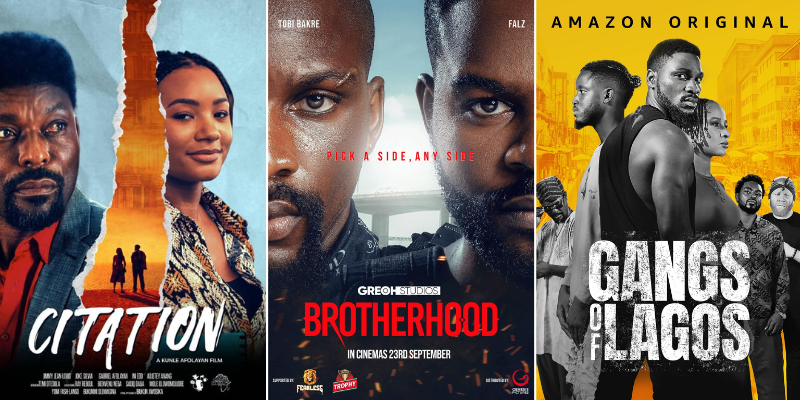
There was a time when Nollywood movies had to fight for recognition. Tight budgets, rushed productions, and a straight-to-CD culture defined an era the industry has since outgrown.
Today, high-budget Nollywood films are building cinematic universes, securing international deals, dominating streaming platforms, and delivering production quality that stands confidently alongside global cinema.
This list isn’t just about good movies. It highlights the high-production Nollywood films that marked a turning point – bold, ambitious projects that proved the industry is no longer playing small.
Here are the top 10 high-production Nollywood movies that helped redefine the industry’s standards and changed how African cinema is seen globally.
King of Boys (2018)
Directed by Kemi Adetiba.
If Nollywood had a “we’ve arrived” moment in modern political crime storytelling, King of Boys is sitting comfortably at the table.
Starring Sola Sobowale, Adesua Etomi-Wellington, and Reminisce, the film dives into the chaotic, power-hungry world of Alhaja Eniola Salami, a woman who doesn’t just enter politics, she dominates it. It was released almost a decade now and it’s still lives in the minds of everyone who saw it.
This wasn’t just a film, it was an experience. The scale, the dialogue, the pacing, the character depth; Nollywood had never handled political crime with this much confidence and control. And let’s be honest, Sola Sobowale didn’t act, she owned that role.
Wedding Party (2016)
Directed by Kemi Adetiba
Produced by Mo Abudu
This is the film that said: “What if Nollywood leaned fully into luxury?”
With Banky W and Adesua at the center of a chaotic Lagos wedding, everything about this film screamed money well spent. What should be a perfect high-society Lagos wedding quickly unravels into chaos as family tensions, secrets, and unexpected drama take over the big day. Released a decade ago and safe to say, It normalized cinema culture in Nigeria. Clean visuals, premium set design, and a story that was both accessible and entertaining. This film didn’t just perform, it shifted audience expectations permanently.
Citation
Directed by Kunle Afolayan
A film that said we can be socially conscious and still look cinematic.
Starring Temi Otedola and Jimmy Jean-Louis as main characters, Citation follows a university student navigating a sexual harassment case against a powerful lecturer. A brilliant student accuses a respected lecturer of sexual harassment, triggering a tense institutional battle that exposes power dynamics within academia.
It was a global Netflix release with strong international visibility. From Ghanaian locations to multilingual dialogue, this film blurred borders. It proved Nollywood could tell relevant, global stories with technical excellence.
The Figurine (2009)
Directed by Kunle Afolayan
Before high-budget Nollywood became a trend, The Figurine quietly walked so others could run. Two friends discover a mysterious statue believed to grant seven years of good luck followed by seven years of misfortune, and their lives begin to reflect that unsettling pattern.
With Ramsey Nouah and Omoni Oboli, the film explores fate, luck, and the supernatural through It had a box office of ₦30 million (huge for its time). Lighting, sound, cinematography – this film treated Nollywood like cinema, not just content. It sparked the New Nollywood movement.
October 1 (2014)
Directed by Kunle Afolayan
A period drama that understood the assignment and over-delivered. Set just before Nigeria’s independence, the film follows a detective investigating a series of murders.
Attention to detail? Insane. Costumes, language, set design, everything felt historically grounded. Nollywood proved it could do serious, layered storytelling with precision.
Aníkúlápó (2022)
Directed by Kunle Afolayan
This one said culture is luxury.
With Kunle Remi and Bimbo Ademoye, the story blends Yoruba mythology, power, and consequence into a visually rich story. Saro, a man seeking a better life, becomes entangled in a forbidden affair with a queen and is killed, only to be resurrected through mystical powers that come with dangerous consequences. Aníkúlápó was top 10 on Netflix across multiple countries. From costume to set design, Aníkúlápó delivered a full cultural immersion. It wasn’t just beautiful, it was intentional.
Gangs of Lagos (2023)
Directed by Jade Osiberu
A group of childhood friends grow up in Isale Eko and become entangled in political thuggery, crime, and survival as loyalty is constantly tested. With Tobi Bakre and Adesua Etomi, the film dives into street politics and survival in Isale Eko. Gangs of Lagos was one of Prime Video’s most talked-about African originals at release.
It delivered tight action choreography and gritty realism; Nollywood rarely executes this cleanly.
Explosive. Loved for action and intensity, controversial for cultural portrayal. Either way, people were talking.
Funmilayo Ransome-Kuti (2024)
Directed by Bolanle Austen-Peters
Starring Joke Silva, Kehinde Bankole, Ibrahim Suleiman, Funmilayo Ransome-Kuti tells the story of Funmilayo Ransome-Kuti—a fearless activist and one of Nigeria’s most influential women. The film follows her journey from an educated young woman to a powerful political figure who challenged colonial rule and fought for women’s rights through the Abeokuta Women’s Union. It also balances her public activism with her personal life, showing the sacrifices behind her strength.
The film shines through its strong performances, detailed period production, and controlled storytelling. It doesn’t overdo drama, it focuses on clarity, emotion, and historical accuracy, showing that Nollywood can handle biopics with real depth and intention.
Viewers widely praised Kehinde Bankole performance and the film’s educational value. While some found the pacing a bit slow, many appreciated its message and relevance.
Brotherhood (2022)
Directed by Jade Osiberu
Starring Tobi Bakre and Falz, twin brothers raised in hardship take drastically different paths; one becomes a law enforcer, the other a criminal, leading to a high-stakes collision. Ambitious set pieces, especially the train heist.
Nollywood is stepping confidently into large-scale action filmmaking. Very well received commercially. Viewers praised the action and pacing, though some critiques noted a lack of story depth. Still, it delivered what audiences came for.
Half of a Yellow Sun (2014)
Directed by Biyi Bandele
Plot:
Two sisters navigate love, class, and identity during the Nigerian Civil War, as their lives are reshaped by conflict and survival. Adapted from Chimamanda’s novel, this film came with global expectations and met them.
Featuring Genevieve Nnaji, John Boyega, Thandiwe Newton and Chiwetel Ejiofor, it tells a love story set during the Biafran war.
It raised the bar during its release because of the international casting, production scale, and emotional depth; this was Nollywood stepping into global cinema conversations.