





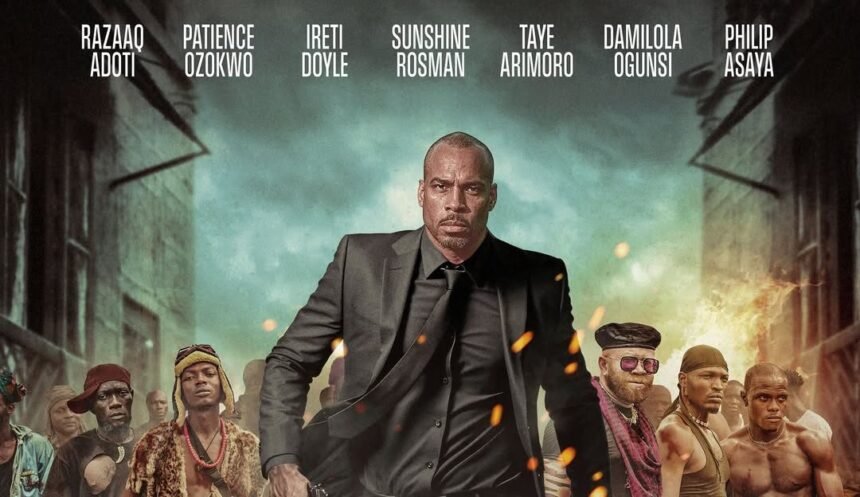
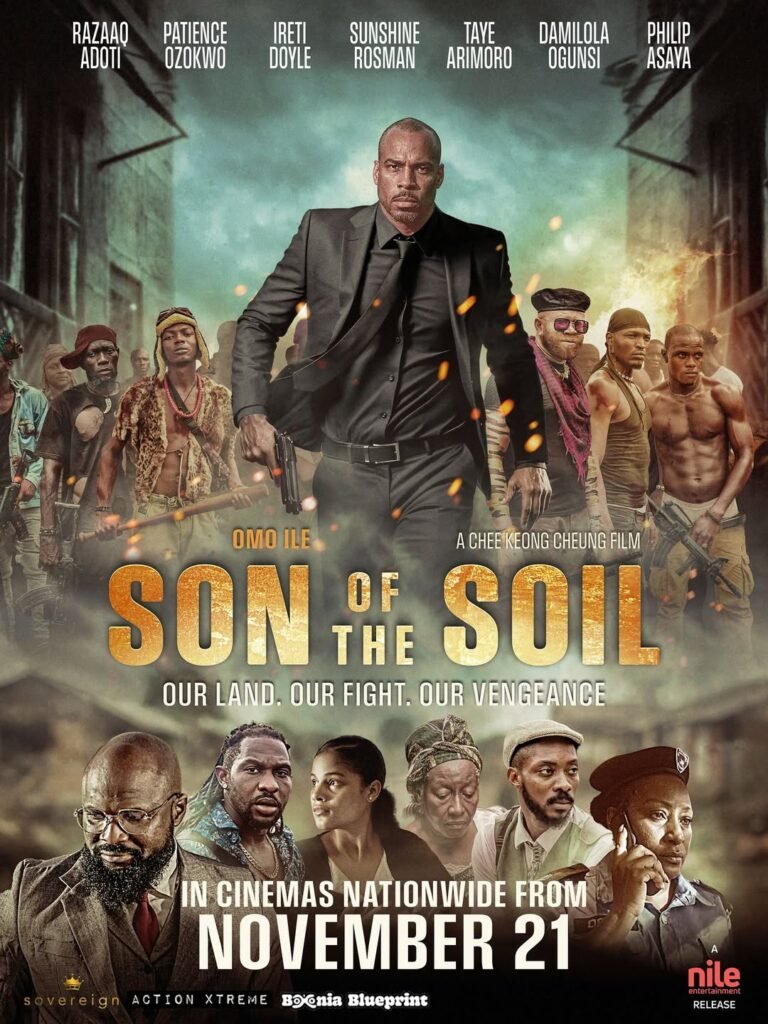
A UK–Nigeria co-production directed by Chee Keong Cheung and written by and starring Razaaq Adoti, Son of the Soil arrived on Netflix this March after an earlier cinema release last December.
Filmed on the bustling streets of Lagos, the film unfolds as a gritty revenge thriller. It follows a dishonourably discharged soldier who returns home hoping to protect his sister, but circumstances drag him into a brutal path of vengeance that quickly spirals into a violent reckoning.
Plot
Son of the Soil wastes no time throwing you straight into the chaos. The film opens with a grim news report about a deadly street drug called Matrix, a chemical nightmare flooding the streets of Lagos and leaving bodies in its wake. People are dying, the city is buzzing, and something dark is clearly brewing beneath the surface.
Then we meet Ronke. It’s just another frantic Lagos morning, horns blaring, people rushing, life moving at full speed. Ronke, a young hotel worker trying to make an honest living, is simply going about her job when fate deals her the worst possible hand. She walks into the wrong room to change into her work outfit because she is running late, but ends up witnessing something terrifying.
Inside, a young woman is being used as a human experiment for a new and more dangerous version of the Matrix by Doctor Baptiste. When the test inevitably turns fatal, Ronke secretly records the horror on her phone. But in a place run by monsters, secrets don’t stay hidden for long. The man behind the drug empire and his pack of thugs. They catch Ronke before she can escape. As if to mock her desperation, Baptiste injects her with Matrix. Dizzy, terrified, and fighting to stay alive, Ronke runs. With shaking hands, she manages to send a voice message to her brother, Zion, warning him that someone is trying to kill her. But the message cuts short. Before she can say anything more, Baptiste’s van barrels into her and runs her down in cold blood.
Her death might have disappeared into the endless tragedies of Lagos, except two people see it happen. One is Nike, too terrified to speak after Baptiste’s men threaten her. The other is an unexpected witness: a little street girl who survives by roaming the city, begging and selling whatever scraps she can find. That small detail changes everything.
When Ronke’s brother, Zion Ladejo, returns from the United States, the authorities are quick to close the case. Drug overdose, they say. After all, Ronke once struggled with addiction. Easy explanation. Case closed. Except Zion isn’t buying it. A former soldier dishonourably discharged and hardened by prison, Zion has seen enough lies in his life to recognise one immediately. His sister’s death doesn’t sit right with him, and he’s determined to dig until the truth surfaces.
His search drags him deep into Lagos’ criminal underbelly and eventually into the territory known as Zanga Republic, where Baptiste’s ruthless supplier, Shaka, runs the streets. Zion confronts him and gets brutally beaten for his trouble. Shaka and his gang leave him bleeding and barely breathing. Just when it seems like the end, the wandering street girl appears again, this time holding a gun that looks almost too big for her hands. She tries to help, but Shaka quickly bluffs her into backing down. As she runs, he casually kills another man and frames Zion for the murder before calling the police. Now battered, framed, and barely alive, Zion lands in a police cell. And things only get worse.
Commander Obi, the Inspector General, seems unusually determined to keep him locked up, injuries or not. Eventually a sympathetic detective manages to move Zion to a hospital, where he slips into a coma. And just when the story seems stuck, the little street girl returns. She brings Ronke’s phone. The phone she quietly picked up from the crime scene. When Zion wakes and watches the video Ronke recorded, the truth explodes into the open. His sister wasn’t a victim of drugs, she was murdered. And the man responsible is Doctor Baptiste. By the time Commander Obi arrives at the hospital to throw Zion back in a cell, he’s already escaped.

Now the hunt flips. Zion begins preparing for war. He visits Baba for weapons and protection, then tracks down his old brother-in-arms Jagun, who now runs his own corner of the streets. Jagun refuses to openly challenge Baptiste but gives Zion a clever piece of advice: Hit Baptiste where it hurts, his supply and his money. If the drug empire starts bleeding, Baptiste will come looking for the man causing it. And that’s exactly what Zion does. One by one, he starts disrupting shipments, burning routes, and wrecking the machinery of Baptiste’s operation. Suddenly, the hunter becomes the hunted.
Meanwhile, Commander Obi grows increasingly frantic. That’s because she’s secretly on Baptiste’s payroll, and if Zion uncovers too much, the fallout could destroy her too. What follows is a violent tug-of-war between Zion and Shaka’s crew. In the middle of the chaos, Zion takes the wandering girl, whose name we finally learn is Remi and hides her with his mother. But Shaka doesn’t play fair. During a brutal shootout with Shaka’s men, Zion is badly wounded and barely escapes alive before being rescued by Nike. Seeing Zion still out there, Obi makes a ruthless move, using his mother as bait to draw him out.
Before Zion can act, Baptiste reaches the house first. In a moment of pure cruelty, he beats Zion’s mother to death, burns her body, and kidnaps Remi. For Zion, that’s the final straw. Jagun finally steps in and takes the injured soldier to Baba, the mysterious healer who brings him back from the brink. With nothing left to lose and everything to avenge, Jagun decides to stand beside him.
Now the war is personal. And Zion Ladejo is done running. What comes next is pure revenge, a furious march straight toward Baptiste’s empire, and the fight to save Remi before it’s too late.
Cast
Performance-wise, Son of the Soil rests heavily on the shoulders of its lead, and Razaaq Adoti clearly shows up ready for battle. As Zion, he fully commits to the physical demands of the role. His presence is imposing, intense, and convincingly dangerous, the kind of man who walks into a room and instantly shifts the temperature. Adoti clearly understands the physical language of action cinema: the stillness before violence, the controlled menace, the economy of movement. Dressed mostly in a sleek black suit and carrying a quiet, soft-spoken demeanour, Zion often feels like a Lagos-flavoured echo of John Wick. But where the performance slightly falters is in emotional depth. The vulnerability that could have elevated Zion beyond the archetype rarely surfaces. We’re told he’s grieving, told he’s hurting, but we don’t always feel it. The few moments where the emotional cracks appear are during his near-death sequences, when flashbacks of his sister briefly break through his hardened exterior.
One of the film’s most pleasant surprises comes from young Ijelu Folajimi, who plays Remi. She brings a refreshing naturalness to the screen. Her performance feels effortless and lived-in. Sunshine Rosman’s Nike operates quietly in the background but remains effective, serving the story with subtlety rather than spectacle. The same can be said of Philip Asaya as the villainous Baptiste. Interestingly, Asaya is the type of actor one might typically expect to see in a more physically dominant role like Zion or even Shaka. Here, as the calculating mastermind, his performance feels somewhat underutilised, a character with potential menace that never fully gets to stretch its legs.
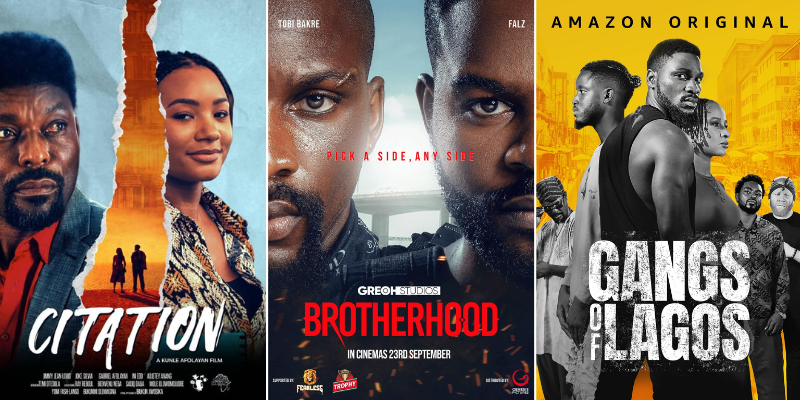
Then there’s Taye Arimoro as Shaka. His performance is energetic and committed, but the fit isn’t entirely seamless. It sometimes feels like a casting choice that doesn’t fully align with the character’s essence. While Arimoro certainly delivers in terms of effort and intensity, the portrayal occasionally slips into familiar Nollywood territory rather than carving out something distinct.
Veteran actresses Patience Ozokwor and Ireti Doyle inject their scenes with a theatrical gravitas that instantly adds texture to the film. Perhaps the most notable missed opportunity is Sharon Rotimi as Ronke. As the emotional trigger for Zion’s entire revenge journey, her role is crucial, yet the film gives her very little screen time to make that impact truly land.
Language
A perfect blend of pidgin, English, and Yoruba.
Final take
One thing Son of the Soil gets very right is its sense of place. Director Chee Keong Cheung doesn’t try to polish Lagos into something sleek or cinematic in the traditional sense. Instead, he lets the city be exactly what it is, loud, crowded, restless, and constantly in motion. The film drops you straight into the middle of everyday Lagos life and lets the chaos speak for itself.
Because the movie is shot entirely on location, the atmosphere feels authentic. We see packed danfos squeezing through impossible traffic, kekes darting between cars and used for escape (very Lagos by the way) , open-air markets buzzing with traders and customers, trenches glowing at night from cigarettes and lighters, and the constant noise of people simply trying to survive another day. Lagos isn’t just where the story happens; it feels like a living character inside the film.
And when the action starts, Cheung handles it with confidence. The fight choreography is rough and raw. No overly polished superhero moves here, just fists flying, bodies slamming, and the kind of messy violence that actually feels believable. The gunfights too hold their own, from tense confrontations near the river to chaotic shootouts on the streets. The blood looks as real as it should, not cartoonish, not timid, just enough to remind you that the stakes are serious.
Then there’s one completely ridiculous moment, but somehow also brave. Zion staggered straight out of the hospital and wandered into a busy market wearing nothing but a backless hospital gown. It’s the kind of scene that makes you pause and think, “Wait… what?” But at the same time, you have to admire the audacity. Nollywood doesn’t usually go that far (save for some sex scenes), and in moments like that, the film suddenly feels very alive.
The sound design also deserves a nod. In the intro, it felt a bit strange at first, especially when the camera started whipping around quickly, but after a while, it settles into the rhythm of the film and works nicely with the tension on screen.
Where the film begins to wobble a bit is in the writing. The script, written by the film’s lead Razaaq Adoti, paints Zion as this almost mythical avenger: silent, unstoppable, brooding. The kind of man who walks into danger like he owns the place. But beyond the grief over his sister and a few hints about a troubled past, we never really get to know the man beneath the muscle.
It’s impossible not to think of John Wick while watching him. Same quiet menace, same revenge energy, same black-suit aesthetic. But where those films take time to build the world and sit with the character’s grief, Zion sometimes feels like he’s moving through the story on autopilot. We’re told he’s hurting, but we don’t always feel that pain with him.
At some points, the story leans so heavily on familiar Hollywood revenge formulas that it starts to feel a bit predictable. Even Remi, the stubborn little street girl who keeps popping up around Zion, sometimes feels like that classic movie trope: the annoying companion who follows the hardened hero around until he eventually softens (more like a stray dog template).
Ronke, Zion’s sister, also ends up feeling more like a plot device than a person. Her death is what drives the entire movie, but she’s barely given enough time on screen for us to really connect with her. Even the moment where she pulls out her phone to record the crime feels slightly awkward, almost like she somehow knew something terrible was about to happen before it did. Since the entire story hangs on that moment, it makes the foundation of the plot feel a little shaky.
The villains also feel a bit thin. Someone like Doctor Baptiste should be terrifying, a man powerful enough to control the streets and manipulate people from the shadows. But we rarely see that power actually unfold. The character has such an interesting idea behind him: a man who presents himself as a healer while secretly spreading destruction. There was real room to explore that psychological contrast.
Still, for all its flaws, Son of the Soil swings big. It’s ambitious, energetic, and clearly trying to push Nollywood action cinema into bolder territory. When it focuses on its action and the pulse of Lagos itself, the film is genuinely exciting. When it slows down to tell the story underneath all that chaos, that’s where it could have dug a little deeper.