





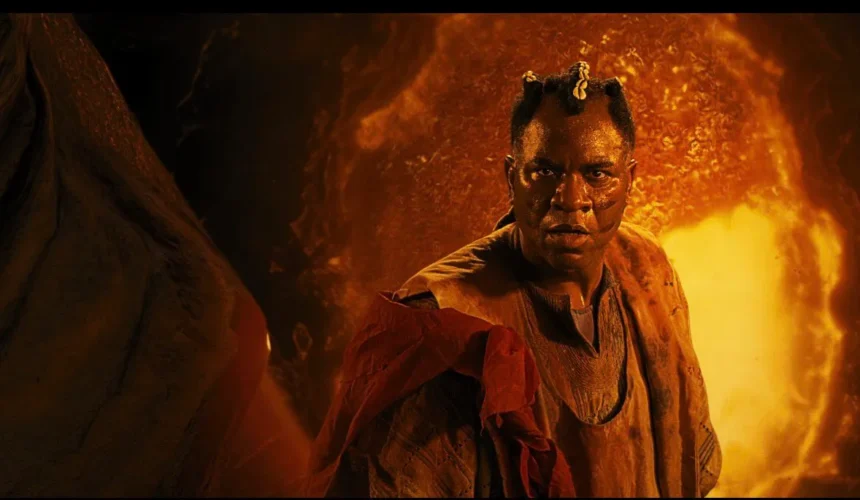

Kunle Afolayan introduced the second season of Aníkúlápó, tagged ‘The Ghoul Awakens’, with Saro suspended between worlds, a ghost of who he was, clawing his way back to humanity as the wreckage of his past catches up with him. His stolen life-force hasn’t disappeared; it has war reveal, mutating into something darker, something hungry.
Meanwhile, Arolake, now rich, powerful, and politically untouchable, is dragged back into the volatility of Oyo. Her mission is urgent: rescue Princess Omowunmi from Portuguese captors. But returning home means confronting old loyalties, buried guilt, and a system built on blood and bargains.
Across five tightly woven episodes, the series pulls no punches, exposing the brutal machinery of the slave trade, interrogating the spiritual price of ambition, and introducing a chilling ghoul mythology that reframes power as theft, not destiny.
Plot
Saro’s story begins where judgment should have ended. Caught between the afterlife and absolution, he refuses his fate and slips through the narrow passage between judgment and sacrifice, forcing his way back into the land of the living. But resurrection comes at a price. To appear human, Saro or the Ghoul must continuously take a life, or he burns from the inside out. Now trapped in a fragile body, he searches desperately for a permanent escape from a curse that refuses to loosen its grip.
Back in the mortal world, Prince Aderoju returns to Oyo only to discover that Omowunmi has been taken by the people of Ede. Following the death of the crown prince, tradition demanded that she marry his successor, Prince Asiru, the younger brother. The union was meant to prevent war, even though it shattered an existing truce. Asiru, however, refuses to force her hand. Omowunmi recoils at the sight of him, and though he desires her, he would rather let her return home than claim her through violence.
Elsewhere, Arolake and Akin finally return home, only for Arolake to discover she is four months pregnant, an unexpected blessing that feels like restitution for past losses. But joy fades with time. After their son is born, finances tighten, exhaustion sets in, and resentment quietly brews. Hope briefly resurfaces when Akin considers joining a traveling singing troupe, but Arolake’s unease grows when she notices the undeniable chemistry between him and the troupe’s female lead.
Determined to check on Omowunmi, Prince Aderoju journeys to Ede and finds her deeply unhappy, still unmarried, and emotionally fractured. He convinces the Kabiyesi to allow her return to Oyo but once home, Aderoju keeps her presence hidden, unsure how to defy the political consequences of her return.
Tension escalates in Oyo as people begin to disappear. Whispers spread, and suspicion falls on Awarun, a known slave trader who has operated unchecked for years. The king summons her and issues a final warning to end the trade or face the consequences. Meanwhile, as Aderoju and Omowunmi debate how to reveal the truth of her return, the king unexpectedly discovers them. Enraged, he orders Aderoju to return Omowunmi to Ede immediately, warning that her presence could ignite war. With no leverage left, Aderoju submits.
Fate, however, intervenes. While hunting, Aderoju encounters something ancient and unspeakable in the forest, the Ghoul. The creature nearly drains the life from him before disappearing. He is found alive but unconscious, suspended between breath and death for weeks. Desperate, the priest presents the king with a horrifying option to sacrifice another child to save the prince. The king refuses. But the Arosonyin reveals a devastating truth, Aderoju has another child living in secret.
At the same time, Omowunmi attempts to flee Ede, wandering into the forest in search of freedom. She meets travelers claiming to be headed for Oyo, only to be betrayed and sold into slavery to the Portuguese.
As chaos deepens, Akin disappears for longer than expected, and tragedy strikes when a woman disguised as a medicine seller kidnaps Arolake’s child pulling every storyline toward an inevitable collision.
Cast
Aníkúlápó: The Ghoul Awakens boasts a wildly rich and intentional cast, stretching effortlessly from revered veterans to compelling new-generation performers. From Taiwo Hassan, Sola Sobowale, Owobo Ogunde, Bimbo Ademoye, to younger standouts like Gabriel Afolayan, Lateef Adedimeji, Eyiyemi Afolayan, Moji Afolayan, Aisha Lawal, and Bukumi Adeaga-Ilori, the lineup feels both expansive and deliberate.

No performance feels undercooked. Everyone came prepared, grounded, and fully embodied, whether playing royalty, warriors, lovers, or villains. What makes the casting especially striking is the collective commitment to old Yoruba intonation and cadence. The diction is weighty, almost ceremonial, evoking the feel of a classic stage play rather than modern screen dialogue. It adds gravitas, authenticity, and a sense of time suspended, like history being reenacted, not performed.
Language
The film is predominantly in Yoruba, and it truly shines there, through its razor-sharp dialogue, evocative music, ritualistic incantations, and a subtle but effective infusion of Portuguese that reinforces its historical weight.
Final take
Aníkúlápó: The Ghoul Awakens leans heavily into the familiar strengths of a classic Yoruba epic, and to its credit, it doesn’t hold back. The traditional setting is richly realized, the cast selection feels deliberate, and the costumes are largely on point. Even the Portuguese characters were thoughtfully styled, which added a nice layer of authenticity. Visually, the aesthetic was pleasing overall. That said, the tribal marks were a bit distracting, they looked more like face paint than etched marks of culture. And Asiru’s hair and beard? Pure stand-up comedy. Thankfully, these flaws are minor and easy to overlook.
Where the series truly shines is in its video quality. The cinematography is crisp and immersive, capturing the world in all its intended grandeur. However, the CGI is another story. The effects, especially those used for the ghoul, were far too obvious and occasionally excessive, to the point where tension gave way to unintentional comedy. Instead of fear, you sometimes get a chuckle.

Narratively, the plot starts off on shaky ground. The opening feels slightly disjointed, though it eventually finds a structured rhythm, particularly as a continuation of the original film. Still, the pacing is wildly inconsistent. At critical moments, the story drags, pulling the viewer away from the plot rather than deeper into it. This is especially evident between episodes two to four, where so much character movement is happening, yet the ghoul, the supposed central threat, is mysteriously absent. Its destruction feels oddly unnoticed, almost irrelevant.
Ultimately, Aníkúlápó did not need to be a series. The original movie was complete and satisfying on its own. This continuation feels like an overextended narrative struggling to justify its existence. Five episodes in, very little has actually happened, it feels more like a prolonged introduction than a proper second season. New characters, fresh plotlines, and unfamiliar faces are being introduced when this groundwork should have been laid in season one. By the end, you’re left wondering: Isn’t this what the first season was meant to do.