






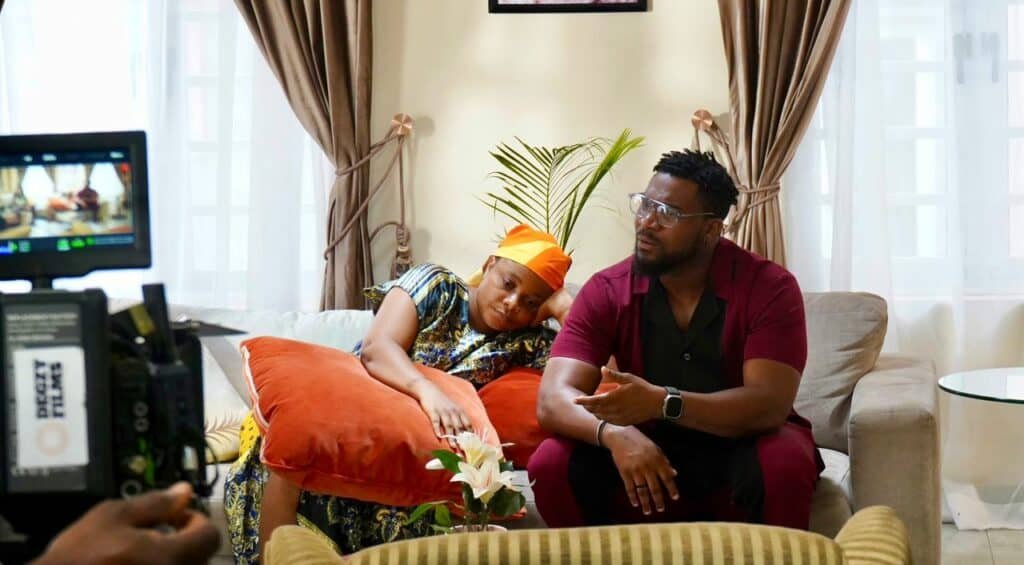
The Benefactor is a bold Nollywood drama produced and directed by Adeoluwa Owu, with a story crafted by Temioluwa Fosudo. At its core, the film confronts one of society’s most silenced realities: sexual assault and the psychological weight carried by survivors who suffer quietly behind admiration, gratitude, and public applause.
Rather than sensationalising trauma, the film approaches it with emotional restraint and narrative depth. The story follows a young woman whose past refuses to remain buried, not because she seeks it out, but because it resurfaces most disturbingly. The Benefactor is not just a drama; it is a statement about truth, survival, and the cost of keeping secrets to protect powerful men.
Plot
The film opens with Tuntunlade, fondly called Tuntun, a fast-rising music artist commanding attention on stage at an upscale lounge. She is talented, confident, and clearly on the brink of something bigger. The applause fades, but the night does not. After her performance, she is greeted warmly by her boyfriend and a man she refers to as “Uncle”, her long-time benefactor who has just returned from abroad.
His presence carries weight. He is the man who sponsored her education, supported her dreams, and positioned himself as her guardian figure. She speaks of him with visible gratitude.
Yet, in a brief and unsettling exchange, the atmosphere shifts. He asks her if she is still “keeping herself”, a coded question about her virginity. She reassures him that she is, insisting she has not been intimate with her boyfriend. The moment lingers uncomfortably. They take a celebratory photograph together: Tuntun, her boyfriend, and the uncle. By morning, the picture is trending. And from the post, someone who ran into her wanted to strike up a conversation about Mr Oloye, but she dismissed the person.
As Tuntu grows closer to her boyfriend, their relationship deepens, and she eventually becomes intimate with him. Shortly after, she receives a call from her uncle requesting to see her the following week. The meeting location: a hotel. That detail alone carries tension. When she arrives, the unease intensifies. He locks the door. The tone changes. The warmth disappears. What follows are inappropriate advances masked as entitlement. She refuses him. She resists. She leaves disturbed and shaken. He begins calling persistently afterwards. She ignores him.
Distressed and confused, she confides in her boyfriend, who was quite furious. He revealed he had long suspected Oloye’s intentions were never pure. That revelation triggers a flashback.

The story takes us back to when Tuntun was just a teenager, bright, ambitious, and full of promise. It was her SS2 graduation ceremony. She had just been awarded the overall best student. A proud moment. A defining achievement. And yet, as the applause rang out, danger was already closer than she realised.
Tuntu, an orphan, lives with her aunt, her aunt’s husband, and their son, David, the family’s erratic and deeply troubled member. His assault on her marks the story’s first major rupture. Her uncle (aunty’s husband) was the one who initially detected that something was wrong. He proposes legal action against David; however, family loyalty overrides justice. Tuntun’s aunt intervenes, begging that the matter not be reported.
When Tuntun eventually leaves that toxic environment and finds refuge under Mr Oloye’s guardianship, the audience is meant to feel relief. Yet the screenplay subtly plants seeds of discomfort. His control over her education, finances, and personal boundaries grows increasingly possessive.
Years later, when Tuntun evolves into the successful artist introduced at the start of the film, the illusion of safety shatters. Mr Oloye’s expectation of repayment, not financially but physically, reframes his past generosity as a calculated investment.
The hotel confrontation marks the emotional climax of the narrative. After she rejects his advances, the story escalates dramatically: her kidnapping and assault shift the tone from psychological tension to outright betrayal.
From there, the film transitions into a legal and public battle. The scandal dominates headlines within the story’s universe. Yet Mr. Oloye’s wealth and connections create an atmosphere of impending injustice. The screenplay deliberately heightens this tension, forcing viewers to confront the uncomfortable possibility that influence may once again silence truth.
The final act introduces a secondary victim, a young girl previously assaulted by Mr Oloye, whose tragic end adds narrative gravity. Her sister’s decision to take justice into her own hands culminates in Mr Oloye’s death in a hotel shooting.
The closing scenes, where Tuntun reconciles with her ailing aunt, offer emotional resolution without forced sentimentality.
Cast
Toluwani George as Young Tuntunlade If the adult version of Tuntunlade gives us resilience, the younger version gives us vulnerability, raw, unfiltered, and quietly devastating. Toluwani George delivers a performance that feels startlingly natural. As the bright, ambitious SS2 student crowned overall best, she radiates innocence and promise. Her early scenes are filled with youthful excitement: subtle smiles, proud glances, that soft eagerness of a girl who believes the world is opening up for her. When the assault by David occurs, the shift in her demeanour is not exaggerated. Instead, it’s internalised. Her silence becomes heavy. Her body language changes: withdrawn shoulders, guarded eye contact, and a visible shrinking into herself. She doesn’t overplay the trauma; she lets it simmer beneath the surface. That restraint makes it more believable and far more painful.
Then there is Akin Lewis as Oloye Olowookere, measured, composed, and disturbingly controlled. His portrayal of Mr Akin Lewis as Oloye l is not loud or theatrically villainous. Instead, it is sophisticated and layered. He embodies the polished philanthropist with effortless authority. His voice carries calm assurance. His posture commands respect.
Bimbo Ademoye as Tuntunlade delivers emotional depth in the present timeline, balancing strength with vulnerability. Her chemistry with Kunle Remi (Ayoola) adds warmth to an otherwise heavy narrative.

Tobi Makinde as David effectively embodies recklessness and moral decay, while Joke Muyiwa as Mrs. Adunni brings maternal conflict to life, torn between justice and protecting her son. Other actors were Bimbo Manuel, Aisha Lawal and Kitan Bukola.
Language
Predominantly in English Language with a perfect blend of Yoruba.
Final take
First things first: the plot carried this film. The backstory wasn’t just added for drama, it was engineered. Every flashback fed directly into the present-day tension, and the transition between timelines felt intentional, not forced. What started as a seemingly simple narrative about a rising artist and her benefactor slowly unfolded into the central conflict of the entire film. And that gradual escalation? Chef’s kiss.
The storytelling didn’t rush. It simmered. It planted seeds early and let them grow into something heavy and unavoidable. That kind of narrative patience is rare, and it worked beautifully here. The film tackled something deeply meaningful, yet delivered it in a way that kept viewers locked in. Important, but never boring. Heavy, but never preachy.
Visually, this film understood the assignment. The camera work was intentional, clean framing, thoughtful angles, and positioning that subtly amplified tension without screaming for attention. Scenes weren’t just shot; they were composed.
And then there’s the setting. The recreation of the early 2000s was impressively detailed. From the plates on dining tables to the architecture of the homes, the dusty roads, the cars, and even the costume styling, it felt authentic. Not caricatured. Not overdone. Just right.
It wasn’t nostalgia for aesthetics’ sake. It was visual storytelling. The production design grounded the flashbacks in a believable era, making the timeline shifts seamless and immersive.
The Cast Delivered. Fully. The ensemble cast showed up and showed out. Every performance felt intentional. No one seemed confused about their character’s emotional weight. The delivery was confident across the board, from vulnerability to menace to moral conflict. It’s one thing to have a good script; it’s another to have actors who understand its depth. This cast clearly did.
The Ending: Justice or Justified? Now let’s talk about that ending. Was death a better form of justice than legal conviction? That’s the question the film leaves hanging and it does so deliberately. The courtroom route might have offered closure through the system. But the route the film chose? It delivered emotional satisfaction. It was shocking, bold, and undeniably impactful.
And if we’re being honest? It felt satisfying.
Not because violence is the answer, but because the truth was finally exposed. The mask fell. The narrative shifted. The “benefactor” was seen for who he truly was.