






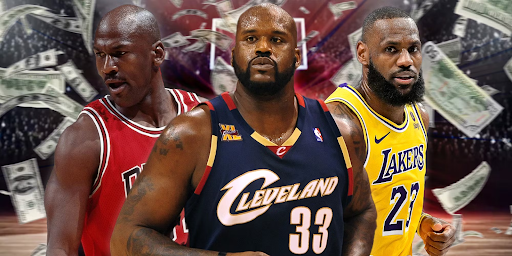
The popular assumption is simple: NBA players get paid enormous salaries, and that is why they end up rich. The reality is considerably more interesting. When you actually map the career earnings of the wealthiest basketball players in history against their final net worth, the numbers rarely match. For most of the richest NBA players of all time, the salary was just the starting capital — not the destination.
This matters particularly for African basketball fans, who follow the NBA closely as both sport and economic case study. South African audiences, for instance, track NBA schedules, scores, and player movements through mobile platforms — the betway app being one of the widely used tools for engaging with live sport in the country. But the financial story unfolding behind the games is, in many ways, more instructive than the games themselves.
Michael Jordan earned roughly $94 million in total NBA salary across 14 seasons. His estimated net worth today sits at approximately $3.5 billion. That means his playing contract accounts for less than 3% of his current wealth. LeBron James, the first active NBA player to reach billionaire status, earns close to two-thirds of his annual income from business ventures, not basketball. These are not exceptions. They are the rule at the very top.

The Richest NBA Players: Salary Earned vs. Final Wealth
The gap becomes clearest when you lay out the data. Below are ten of the richest basketball players in history, with approximate career earnings in salary alongside current estimated net worth:
| Player | Origin | Career Salary (approx.) | Est. Net Worth | Primary Wealth Driver |
| Michael Jordan | USA | $94M | $3.5B | Jordan Brand / Nike equity |
| Magic Johnson | USA | ~$40M | $1.5B | Team ownership, real estate |
| LeBron James | USA | $400M+ | $1.2B | Media, equity stakes |
| Junior Bridgeman | USA | ~$3M | $600M | Restaurant franchises |
| Shaquille O’Neal | USA | $292M | $500M | Endorsements, franchises |
| Vinnie Johnson | USA | ~$20M | $500M | Automotive manufacturing |
| Kevin Durant | USA | $450M+ | $300M | Media, VC investments |
| Hakeem Olajuwon | Nigeria | $110M | $300M | Real estate |
| Russell Westbrook | USA | $350M+ | $300M | Fashion, real estate |
| Luol Deng | South Sudan | ~$140M | $200M | Hotel and property portfolio |
African-Born Players and the Quiet Wealth Strategy
Hakeem Olajuwon earned just over $110 million in salary across 18 NBA seasons. His net worth today is estimated at $300 million. That gap did not happen by accident, and it did not happen because of endorsement deals or media ventures. It happened because Olajuwon started buying Houston real estate while he was still playing — and kept buying, systematically, for years after retirement.
The practical mechanics are worth understanding. During his peak earning years with the Rockets, Olajuwon purchased downtown Houston parking lots, commercial buildings, and residential properties. He operated without debt where possible, which meant he was not exposed to the kind of leverage that ruins athletes who invest during high-income years and then face repayments once contracts end. By the time Houston’s real estate values had appreciated, he held a portfolio worth several times his original investment. Twelve parking lots purchased quietly in the early 2000s became the foundation of what one financial profile called his “Concrete Empire.” The asset class was unglamorous. The returns were not.
Luol Deng ran a similar playbook, just in a different market. Born in what is now South Sudan, Deng spent his NBA career accumulating rather than spending at the pace his contracts allowed. Post-retirement, he moved aggressively into hotels, resorts, and residential property. His estimated net worth of $200 million is built almost entirely on that portfolio — not on his basketball name.
The pattern in both cases is identical: earn during the playing window, invest in hard assets with long appreciation timelines, avoid lifestyle inflation that forces you to liquidate early. Neither player needed a global brand or a media company. They needed patience and a clear understanding that the salary had an expiry date, and the asset base did not.
Dikembe Mutombo, from the Democratic Republic of Congo, chose a different application of the same principle. He directed resources toward infrastructure — most concretely, the Biamba Marie Mutombo Hospital in Kinshasa, built with his own funds. Mutombo passed away in September 2024, aged 58. What he left behind was not a financial empire in the conventional sense, but a functioning hospital in a city of over 17 million people. The asset he built simply happened to be a public one.
Three African-born players. Three distinct applications of the same core logic: don’t treat the salary as the endpoint.
What the Richest Players Did Differently
The salary-to-net-worth gap in NBA history breaks down into a few consistent patterns:
- Equity over endorsements: Jordan did not take a standard Nike deal in 1984. He negotiated a sales royalty — a share of revenue — which became the foundation of the Jordan Brand, now generating over $5 billion in annual revenue for Nike.
- Asset acquisition during peak earning years: Olajuwon and Deng bought property while salaries were still flowing in, avoiding the cash-out-and-spend pattern that has ended careers of financially.
- Business equity, not just appearances: LeBron James holds minority stakes in Liverpool FC and Blaze Pizza. Magic Johnson has ownership positions in the Los Angeles Dodgers and Washington Commanders. These stakes appreciate independently of any further work.
- Media and IP: Kevin Durant’s Boardroom media company and LeBron’s SpringHill Entertainment operate on the same model — athletic credibility as the initial currency, converted into intellectual property that generates returns long after retirement.
The players who ended up richest treated the NBA salary as a limited runway. What you build before the runway ends determines almost everything else.
The Bigger Picture for African Basketball
Africa produces more NBA players today than at any point in the league’s history. Nigeria, Cameroon, the DRC, and South Sudan have all contributed players to modern rosters. The financial trajectories of Olajuwon and Deng are proof that the path from African basketball to generational wealth is well-traveled — but it requires strategy, not just talent.
The richest NBA players of all time were not simply the highest-paid athletes in the world during their playing years. They were the ones who treated the court as a launchpad. For African basketball fans watching the league, that shift in perspective may be the most valuable thing the sport has to offer. The salary figures are impressive. What comes next is the actual story.